
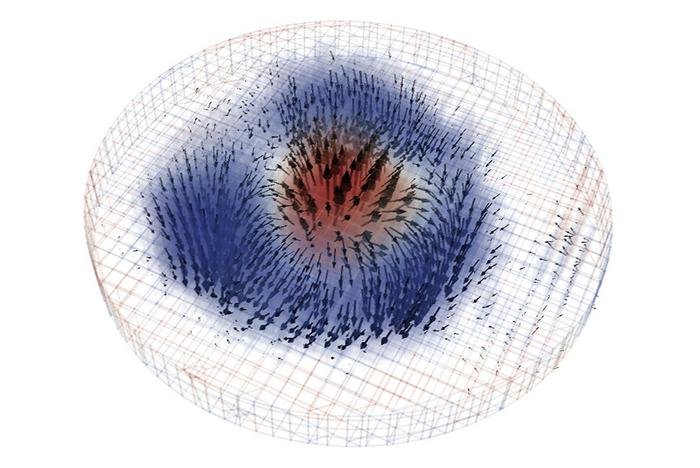
قد يؤدي جسم نانوي يصعب وصفه يسمى السكيرميون المغناطيسي إلى ظهور أجهزة إلكترونية دقيقة جديدة في يوم من الأيام يمكنها القيام بالكثير - مثل تخزين كميات هائلة من البيانات - مع استهلاك طاقة أقل بكثير.
ولكن لكي يتمكن الباحثون من استخدام السكيرميونات بشكل موثوق في الأجهزة الحاسوبية، بما في ذلك أجهزة الكمبيوتر الكمومية، يجب عليهم فهمها بشكل أفضل. قاد بيتر فيشر، الباحث الرئيسي في مختبر لورانس بيركلي الوطني (مختبر بيركلي) التابع لوزارة الطاقة، مشروعًا لإنشاء صور ثلاثية الأبعاد بالأشعة السينية للسكيرميونات، والتي يمكن استخدامها لتوصيف أو قياس اتجاه الدوران في الجسم بأكمله. قال فيشر: "تضع نتائجنا الأساس لتقنية النانومتر لأجهزة الإلكترونيات الدوارة". تم نشر العمل مؤخرًا في مجلة Science Advances.
يمكنك التفكير في السكيرميونات المغناطيسية على أنها دوائر مغناطيسية دوارة، كما يوضح ديفيد رافتري، الباحث الطالب في فريق فيشر، والذي كان المؤلف الرئيسي لهذه الدراسة. في المركز، يشير الدوران المغناطيسي إلى الأعلى، بينما يدور المغناطيس بعيدًا عن المركز ويتجه إلى الأسفل. علاوة على ذلك، فإن السكيرميونات مستقرة وصغيرة وسريعة ولا تتفكك بسهولة، وهي خاصية يسميها علماء المواد "طوبولوجية".
These spin orientations are part of the appeal of skyrmions, as they could be used to transfer and store information, similar to how electrons transfer and store information in current devices. "However, if you rely on the electron's charge, as is done today, energy is inevitably lost. When using spins, the losses are significantly lower," said Fischer.
However, the theoretical knowledge about skyrmions was based on their description as 2D objects. In the real world of electronics and silicon wafers – no matter how thin – skyrmions must be treated as 3D objects. To make skyrmions usable, or perhaps to synthesize custom skyrmions one day, researchers need to be able to examine and understand their spin properties throughout the entire 3D object.
If you look at a magnetic skyrmion vortex from above and start slicing off layers, you might think that each layer would be the same as the next. "But that's not the case," said Raftrey. "And we said, okay, how can we get a handle on this? How do we actually demonstrate this?"
Raftrey took a thin magnetic film synthesized by colleagues at Western Digital and used the Molecular Foundry's nanofabrication facility to structure a nanodisk from it. To obtain 3D tomography images, he traveled to Switzerland to apply a novel imaging technique called magnetic x-ray laminography at a microscopy beamline at the Swiss Light Source.
Using x-ray laminography, "you can basically reconfigure and reconstruct [the skyrmion] from these many, many images and data," said Raftrey. This process took months and ultimately led to a better understanding of the spin structures of skyrmions.


