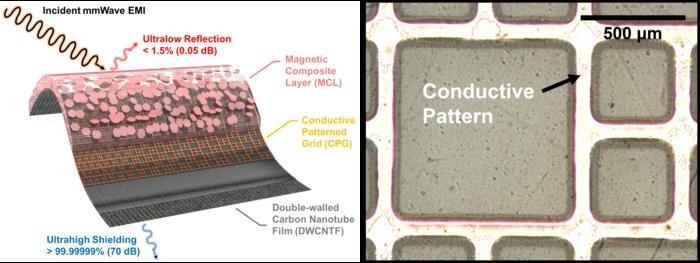
A research team led by Dr. Byeongjin Park and Dr. Sang Bok Lee from the Composites & Convergence Materials Research Division at Korea Institute of Materials Science (KIMS) has developed the world's first ultra-thin film composite material capable of absorbing over 99% of electromagnetic waves across various frequency bands (such as 5G/6G, WiFi, and autonomous driving radar) with a single material.

This electromagnetic wave absorption and shielding material is less than 0.5 mm thick and boasts a low reflectivity of less than 1% and a high absorption rate of over 99% across three different frequency bands.
Electromagnetic waves emitted by electronic components can cause interference, leading to performance degradation in other nearby electronic devices. To prevent this, electromagnetic shielding materials are used. Absorbing electromagnetic waves is more effective at reducing interference than simply reflecting them. However, conventional electromagnetic shielding materials reflect over 90% of waves, with actual absorption often only reaching 10%. Furthermore, materials with higher absorption capabilities are typically limited to absorbing electromagnetic waves within a single frequency band.
To overcome these limitations, the research team developed a composite material that can absorb electromagnetic waves across multiple frequency bands simultaneously. This technology absorbs and eliminates electromagnetic waves, thereby resolving issues with secondary interference. The material is also thin, flexible, and durable enough to maintain its shape even after being folded and unfolded thousands of times, making it suitable for foldable phones and wearable devices.
The team synthesized a magnetic material by altering the crystal structure of ferrite, enabling it to selectively absorb desired frequencies. They fabricated an ultra-thin polymer composite film and applied conductive patterns to the back of the film to control the propagation of electromagnetic waves. By adjusting the shape of the conductive pattern, the reflection of electromagnetic waves at specific frequencies can be drastically reduced. Additionally, a thin layer of carbon nanotubes with high shielding properties was applied to the back to further enhance electromagnetic wave shielding.
Senior Researcher Byeongjin Park of KIMS, who led the project, commented, “As the applications of 5G/6G communication continue to expand, the importance of materials for absorbing and shielding electromagnetic waves is growing.” He added, “This material has the potential to significantly improve the reliability of wireless communication devices such as smartphones and autonomous vehicle radars.”
Original Paper: