

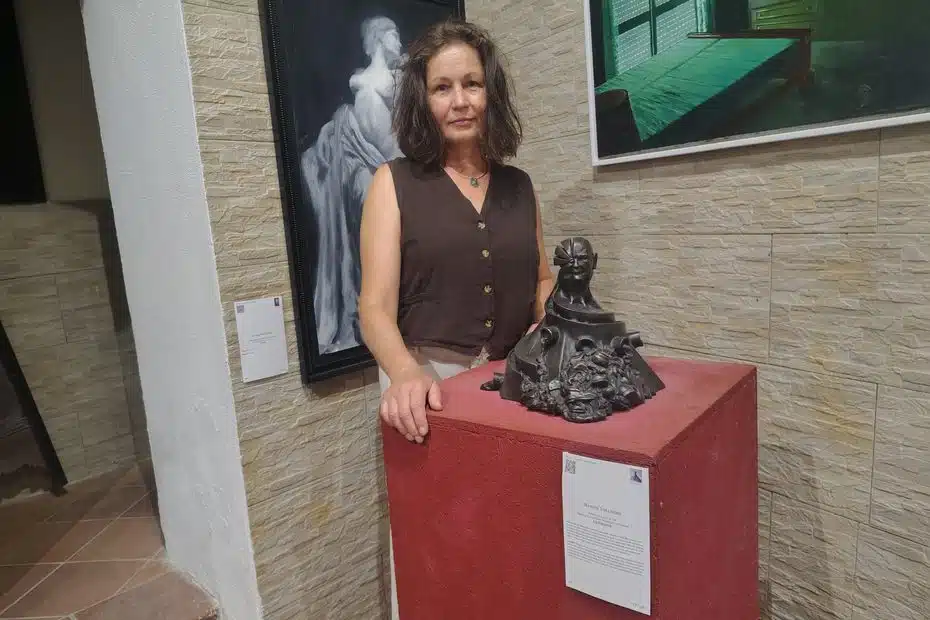
Marita Vollborn is a sculptor, journalist, and grew up in East Germany. Her bronze sculpture "ARES" will be shown at the London Art Biennale in 2027 – but she is currently consciously declining an exhibition in the USA. In this interview, she explains why she respects the Americans' choice but does not accept the erosion of institutional controls, what she recommends to voters before the midterms, and whether Gavin Newsom can be a beacon of hope for artistic freedom.
Marita, your art is political, and you will be exhibiting ARES at the London Art Biennale next year, but not in Washington DC. Why?
Because for me, art shouldn't function under conditions that systematically stifle critical voices. I respect the choice of American voters—that's their democratic decision. But what I cannot accept is the erosion of checks and balances, those institutions meant to limit power. As long as these control mechanisms don't function reliably and the space for critical positions isn't predictably safe, I'm focusing on European platforms. ARES isn't an anti-American work—it's directed against militarism and greed wherever they appear. But I'm showing it where I believe the conditions for challenging art are right.
You've said that you respect the will of the American people in elections, but that you miss functioning checks and balances. What do you recommend to American voters for the midterms next week?
I recommend that they strengthen precisely those institutions that limit power – not those that concentrate it. Democracy is more than just an act of voting; it thrives on the continued existence of functioning checks and balances, on the rule of law, and on the freedom to speak uncomfortable truths. Those who go to the polls should ask: Who defends the independence of the judiciary, freedom of the press, the separation of powers? Who sees art and critical public discourse as part of the democratic infrastructure and not as a disruptive element? The midterm elections are an opportunity to strengthen those forces that understand these checks and balances not as an obstacle, but as a foundation.
Many of your sculptures deal with what defines politicians like Trump. They address power, abuse, greed, and conflicts of interest. Aren't you afraid of being barred from entering the US in the future?
This concern is not unfounded, and it is part of my decision. When I publicly state that I do not want to exhibit under the current conditions, it is a conscious choice—not fear, but a consequence. As an investigative journalist, I have learned over decades that taking uncomfortable positions can have repercussions. But I am not guided by that. Should I ever be denied entry, that would be a commentary on the circumstances, not on my work. The empty pedestal I am accepting is itself a statement.
Does the behavior of the current US government remind you of your East German past?
It reminds me of mechanisms, not identities. I grew up in a system that censored art and free thought, where institutions meant to limit power became tools of power. In 1989, I protested for change along with many others. This experience left a lasting conviction: I know the difference between genuine institutional restraint and its mere facade. When I see developments in the US today where control mechanisms are under pressure, it alarms me—not because I equate America with East Germany, but because I know how institutions can erode when no one defends them.
But there are indeed states that are resisting Trump's behavior. California, for example. Would that be a place to exhibit after all?
I'm following this closely. California does indeed send a signal—for example, in defending artistic freedom, as demonstrated by its legislation protecting artists from having their texts used as evidence. But my decision isn't geographical, it's institutional. As long as the federal framework for critical art and the safety of critical voices remains unreliable, my answer remains the same. This doesn't mean I don't see California as an encouraging sign. It simply means I don't view my work as a trial balloon in a federal conflict.
And Gavin Newsom? Is he the figure of hope who can revive artistic freedom in the USA?
Gavin Newsom, as Governor of California, certainly made his mark – for example, with the "Decriminalizing Artistic Expression Act," which protects artistic expression from criminal prosecution. He also publicly acknowledged the importance of art and free expression. But hope doesn't lie with individuals. Artistic freedom isn't revived by a governor, but by institutions, courts, legislatures, and a public that demands it. I would be cautious about pinning my hopes on a single person. What I see is a signal from California that resistance is possible. Whether this will translate into lasting institutional safeguards is another question.
Thank you for your time.

