Skip to content

Quantum Computing in Medicine

  • News

Quantum computing is considered one of the most promising future technologies for medicine. While classical computers reach their limits with certain complex problems, quantum computers can theoretically perform certain calculations exponentially faster. This opens up entirely new possibilities, especially in drug discovery, personalized medicine, and the analysis of biological systems. Why Quantum Computing is Relevant for Medicine Many medical challenges are extremely computationally intensive: Key Application Areas Application Area Potential of Quantum Computing Current Maturity Level Drug Development Simulation of molecular interactions Early stage (Proof-of-Concept) Protein structure & folding Complement to classical methods like AlphaFold Research Genomics & Big Data Faster analysis of complex genetic data Early stage Medical Imaging Improved image reconstruction and analysis Research Optimization Problems Planning of therapies, logistics, resource allocation First pilot projects Quantum Machine Learning New AI models for diagnostics and prognosis Research Quantum simulation for drug development, in particular, was ranked by the World Economic Forum in 2026 as one of the ten most important emerging technologies. Current status (2026) Quantum computers… 
World Economic Forum and Frontiers Publish Top 10 Emerging Technologies 2026

  • News

Geneva (LabNews Media LLC) – The World Economic Forum (WEF) and the scientific publisher Frontiers have presented the ten most important emerging technologies of 2026. The focus is no longer exclusively on Artificial Intelligence, but on technologies that directly intervene in physical systems – from energy supply to medicine to industrial production. Eight of the ten technologies have a direct impact on real infrastructure, materials, or biological processes. They are intended to help overcome challenges such as climate change, food security, and previously incurable diseases. Among the top technologies are: Stephan Mergenthaler from the World Economic Forum emphasized that the technologies together showed a new pattern: the competitive advantage is shifting from pure software to the control of physical infrastructures, materials, and industrial data. Frederick Fenter from Frontiers highlighted that the technologies with the greatest impact are increasingly moving from the digital to the physical – even though Artificial Intelligence continues to support many advances. The report… 

Digital Health Tools Are Changing Healthcare in the US

  • News

New York (LabNews Media LLC) – Digital health tools such as patient portals and health apps have become an integral part of medical care in the US. This is shown by an extensive study from NYU Langone Health, which analyzed more than 140 million patient records and over 8 billion interactions between patients and medical staff. Between 2020 and 2025, the number of messages patients sent to their providers via secure portals increased by 153 percent. At the same time, the number of phone calls decreased by 6 percent. At least 12 percent of Americans now use portals and apps to schedule appointments, view results, or discuss treatments. However, the study also shows that digital communication does not replace personal doctor visits but complements them. The number of in-person appointments has stabilized again after the decline during the pandemic. "Our study shows that the use of… 

Colon cancer cells can change their identity to form metastases

  • News

New York (LabNews Media LLC) – Colon cancer cells can change their identity to spread to the liver and form new tumors there. This is shown by a study by researchers at Weill Cornell Medicine and the Massachusetts Institute of Technology (MIT). The focus is on the transcription factor GATA6. Normally, it ensures that the cells of the intestinal lining maintain their stable identity. However, in colon cancer cells, the loss of GATA6 causes them to transition to a more primitive, flexible state. They adopt fetal gene programs and switch from LGR5-positive to LGR5-negative cells, which are particularly capable of forming liver metastases. In mouse models, the genetic knockout of GATA6 led to a significant increase in liver metastases without significantly affecting the growth of the primary tumor. Conversely, restoring GATA6 reduced the cancer cells' ability to metastasize. The study suggests that… 

New Gene Network Approach Identifies Over 600 Previously Unknown Schizophrenia Genes

  • News

Baltimore (LabNews Media LLC) – An international research team has identified more than 600 previously unknown genes associated with schizophrenia using a novel gene network approach. The study was published in the journal Nature Genetics. Previous genetic studies have mostly focused on variants located near genes. The team led by Dr. Giulio Pergola from the Lieber Institute for Brain Development has now systematically considered long-range regulatory relationships between genes and gene co-expression networks in the brain for the first time. The analysis was based on genetic data from over 102,000 individuals and brain tissue samples from several brain regions. The researchers identified a total of 641 new genes associated with schizophrenia. The affected biological processes include glutamate signaling pathways, communication between brain cells, immune processes, and brain development. "Most genetic studies have only looked under the streetlight, focusing on genes near disease variants… 

Johns Hopkins Researchers Discover Ancient Neurons That Control Attention

  • News

Baltimore (LabNews Media LLC) – Researchers at Johns Hopkins University have discovered neurons in a very evolutionarily old part of the brain that play a key role in controlling attention. The inhibitory nerve cells, located in the brainstem, suppress distractions, thereby enabling selective spatial attention – in all vertebrates, from fish and birds to mammals. Previously, it was assumed that attention processes were mainly controlled by the highly developed prefrontal cortex. However, the new findings show that a much older brainstem circuit performs this function. When the researchers temporarily deactivated the corresponding neurons in mice, the animals became highly distractible. Even weak disruptive stimuli diverted their attention. The next day, when the neurons were reactivated, the mice were again able to successfully suppress distractions. "A hallmark of ADHD is that even weak distractions pull attention away – and that's exactly what we see here when...

The Dawn of Designed Life: AI and Synthetic Biology as New Creators

  • News

Imagine a living cell whose genetic blueprint was never shaped by eons of trial-and-error evolution on Earth. Instead, it emerges from silicon-based intelligence running generative algorithms on vast oceans of sequence data. This cell divides, metabolizes, and interacts with its environment according to parameters chosen by code. Such scenarios are no longer distant speculation—they represent the accelerating frontier where artificial intelligence meets synthetic biology. This convergence marks a profound shift in humanity’s relationship with life itself. For the first time, non-biological minds are positioned to originate novel biological entities, moving beyond mere modification of existing organisms toward genuine creation. The implications ripple through science, philosophy, ethics, and our understanding of existence. This essay examines the evidence, the disruptions, and the deeper questions this development raises, offering an original perspective on what it means when intelligence becomes the architect of life.… 

AlphaFold – The AI That Has Revolutionized Protein Structure Prediction

  • News

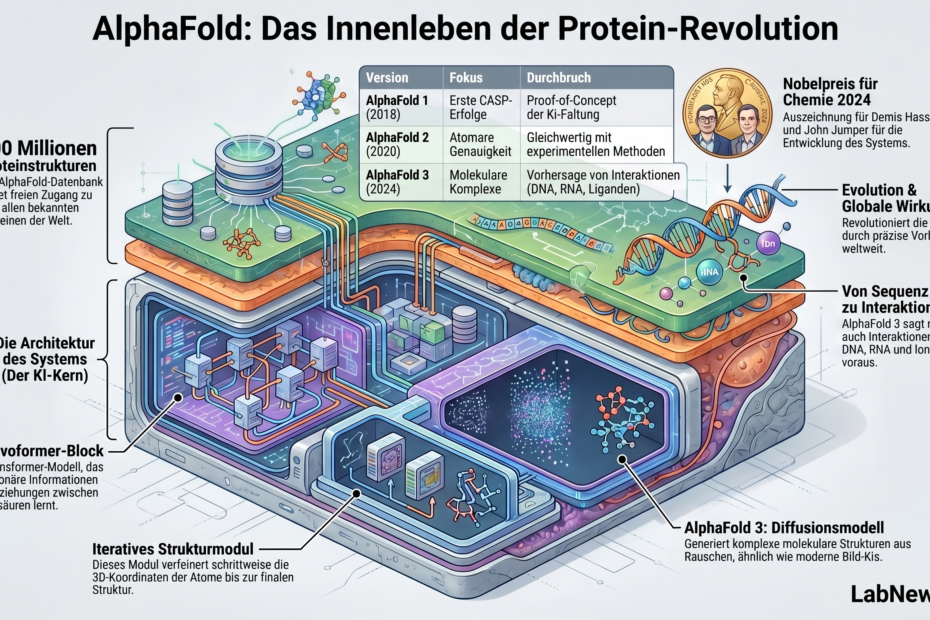
AlphaFold is an AI system developed by Google DeepMind that can predict the three-dimensional structure of proteins with unprecedented accuracy – solely from their amino acid sequence. It is considered one of the greatest breakthroughs in biology in recent decades. What are proteins? Proteins are the molecular machines of life. Their function depends heavily on their three-dimensional structure. For decades, determining this structure experimentally (e.g., using X-ray crystallography or cryo-electron microscopy) was extremely complex and expensive. AlphaFold largely solves this problem through artificial intelligence. How does AlphaFold work? AlphaFold combines several advanced AI techniques: AlphaFold 3 additionally uses a diffusion model (similar to image generators like Stable Diffusion), which generates the structure step-by-step from noise. Impact and Significance Current Developments (as of 2026) John Jumper, who was significantly involved in AlphaFold and led the AlphaFold team, has left Google DeepMind and moved to… 

Nobel laureate John Jumper leaves Google DeepMind and moves to Anthropic

  • News

London (LabNews Media LLC) – John Jumper, one of the lead developers of the AI system AlphaFold and co-recipient of the 2024 Nobel Prize in Chemistry, is leaving Google DeepMind to join the AI company Anthropic. This means Google DeepMind is once again losing one of its most prominent researchers. Jumper led the AlphaFold team, which revolutionized biological research with its technology for predicting protein structures. He worked at DeepMind for almost nine years and took over leadership of the AlphaFold project shortly after completing his doctorate. The move is part of a series of departures from Google DeepMind. In recent months, Noam Shazeer (co-developer of Gemini) to OpenAI and David Silver (key figure behind AlphaGo and AlphaZero), among others, have left the company. Anthropic and OpenAI have thus poached several leading minds from Google in a short period. Neither Jumper himself nor the company has commented on the reasons for Jumper's move… 

Photonic AI system enables ultra-fast medical diagnoses with minimal energy consumption

  • News

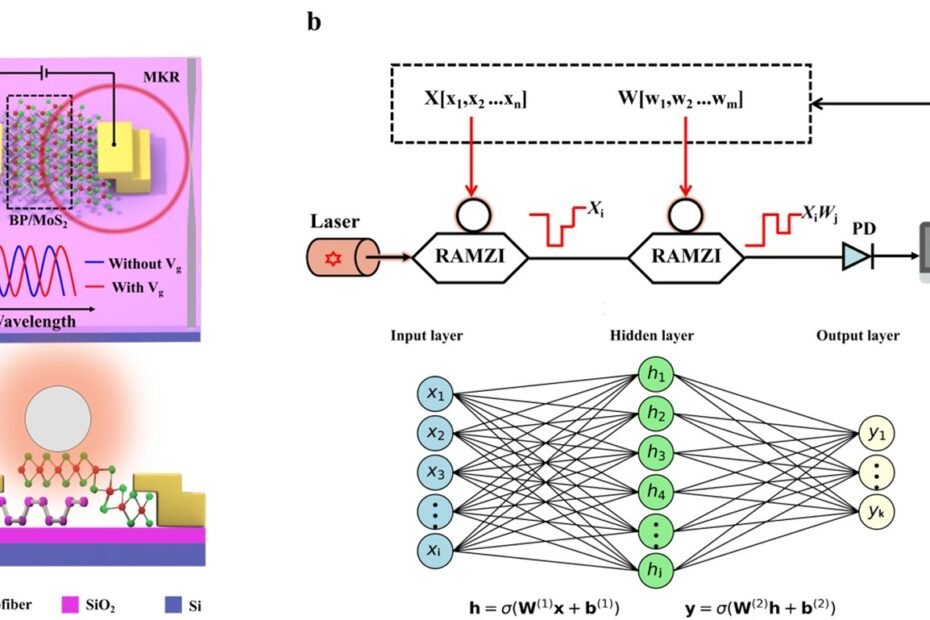
Shenzhen (LabNews Media LLC) – An international research team has developed a photonic AI system that can analyze medical imaging data extremely quickly and energy-efficiently. The system achieved 95 percent accuracy in detecting retinal detachments and liver cell carcinomas in clinical trials. Led by Professor Han Zhang of Shenzhen University, the researchers combined a black phosphorus (BP)-based van der Waals heterostructure with a microfiber ring resonator. This created a fully fiber-based photonic neural network (PNN) platform that uses light instead of electrons for data processing. Diagnosing a liver CT scan took an average of only 0.8 milliseconds – more than 100 times faster than on a high-performance NVIDIA A100 graphics processor. At the same time, the system required only 0.608 femtojoules per computation – 246 times less energy than conventional electronic systems. In tests with real patient data from Shenzhen hospitals, the system achieved a specificity of 97.6 percent. Especially in early stages of liver cancer (tumors under…