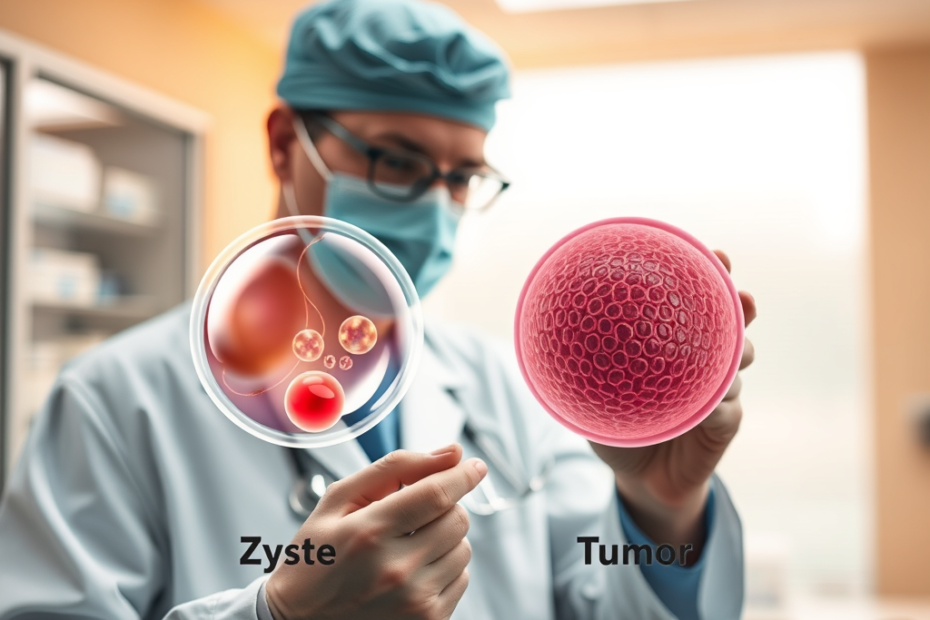
When an unusual growth is detected during a medical examination, many people ask themselves: Is it a cyst or a tumor? Both terms are heard often, but they refer to different things. In this FAQ article, we explain in medically understandable language what cysts and tumors are, how they differ, and what is important in diagnosis.
1. What is a cyst?
A cyst is a benign cavity filled with fluid, gas, or semi-solid material, surrounded by a thin wall (capsule). Cysts can occur almost anywhere in the body, e.g., in the skin, ovaries, breasts, or kidneys.
Characteristics of a cyst:
- Mostly benign (not cancerous).
- Soft or yielding to the touch, as they are filled with fluid.
- Often clearly demarcated from surrounding tissue.
- Can be caused by infections, injuries, chronic inflammation, or genetic factors.
- Examples: Sebaceous cysts, ovarian cysts.
Symptoms: Many cysts cause no discomfort and are discovered incidentally. Larger cysts can cause pressure symptoms (pain, swelling) or be visible.
2. What is a tumor?
A tumor is an abnormal growth of tissue that arises from uncontrolled growth of cells. Tumors can be benign or malignant (i.e., cancer). They consist of solid tissue, not fluid like cysts.
Characteristics of a tumor:
- Benign tumors (e.g., lipomas, fibromas): Grow slowly, are usually well-defined, do not metastasize, and are rarely life-threatening.
- Malignant tumors (e.g., carcinomas, sarcomas): Often grow rapidly, can invade surrounding tissue, and form metastases (secondary tumors).
- Tumors arise from genetic changes that disrupt cell growth.
- They often feel firmer than cysts.
Symptoms: Benign tumors often cause no or only mild discomfort. Malignant tumors can cause pain, weight loss, fatigue, or other symptoms, depending on their location and size.
3. How do cysts and tumors differ?
Here is an overview of the main differences:
| Feature | Cyst | Tumor |
|---|---|---|
| Content | Fluid, gas, or semi-solid | Solid tissue |
| Benign/Malignant | Almost always benign | Benign or malignant (cancer) |
| Consistency | Soft, yielding | Often firmer |
| Growth | Slow, mostly remains local | Benign: slow; malignant: fast, invasive |
| Cause | Blocked glands, injuries, infections | Genetic changes, cell mutations |
| Examples | Sebaceous cyst, ovarian cyst | Lipoma (benign), breast cancer (malignant) |
4. How is the diagnosis made?
Distinguishing between a cyst and a tumor often requires medical examinations, as they cannot always be reliably differentiated by symptoms or palpation alone. Doctors use the following methods:
- Clinical examination: The doctor palpates the growth to assess its size, shape, and consistency.
- Imaging:
- Ultrasound: Shows whether the structure is fluid-filled (cyst) or solid (tumor).
- X-ray, CT, or MRI: Detailed images to assess size, location, and tissue characteristics.
- Biopsy or puncture: A tissue sample or fluid is taken and examined in the laboratory to clarify its nature (benign/malignant).
- Blood tests: Certain tumor markers (e.g., CA-125 for suspected ovarian cancer) can provide clues.
5. Are cysts dangerous? Can they turn into tumors?
- Cysts are usually harmless and often disappear on their own (e.g., functional ovarian cysts). In rare cases, they can become inflamed, rupture, or put pressure on adjacent organs, requiring treatment.
- Some cysts (e.g., certain ovarian cysts) may have a low risk of becoming malignant. Regular check-ups are important here.
- Tumors need to be investigated more closely, as malignant tumors (cancer) require early treatment.
6. When should you see a doctor?
See a doctor if you notice the following:
- A new or growing swelling that does not disappear.
- Pain, redness, or other discomfort in the area of the growth.
- Changes in the skin over the swelling (e.g., color change, bleeding).
- General symptoms such as weight loss, fever, or fatigue (indicating possible malignancy).
7. How are cysts and tumors treated?
- Cysts: Many do not require treatment and only observation. If symptomatic, the cyst can be punctured (fluid aspirated) or surgically removed.
- Benign tumors: Are often removed if they cause symptoms or are cosmetically bothersome.
- Malignant tumors: Treatment often includes surgery, chemotherapy, radiation therapy, or immunotherapy, depending on the type and stage of cancer.
8. Conclusion
Cysts and tumors are different types of growths. While cysts are usually benign, fluid-filled cavities, tumors can be benign or malignant and consist of solid tissue. An accurate diagnosis through imaging, biopsy, or other tests is crucial to determine the right treatment. If you have unclear swellings or symptoms, you should always consult a doctor for clarification.
If you have further questions, speak with your doctor or a specialist who can provide personalized advice.
This article is general in nature and does not substitute medical advice. For health-related questions, please consult a doctor.