In the fight against antibiotic resistance, a new technology developed at Chalmers University of Technology in Sweden could be of great importance, for example, when hip and knee implants are surgically inserted. By heating small gold nanorods with near-infrared light (NIR), bacteria are killed and the surface of the implant becomes sterile. The researchers are now presenting a new study that improves understanding of how the gold rods are affected by light and how their temperature can be measured.
Infections can occur during surgical procedures. The risk increases significantly when foreign bodies such as knee prostheses are implanted into the body. The presence of these substances weakens the body's immune system and often requires antibiotic treatment. High doses of antibiotics and long treatment times, sometimes lifelong, are often required for infections. This carries the risk of increased antibiotic resistance, which is considered by the WHO to be one of the greatest threats to human health.
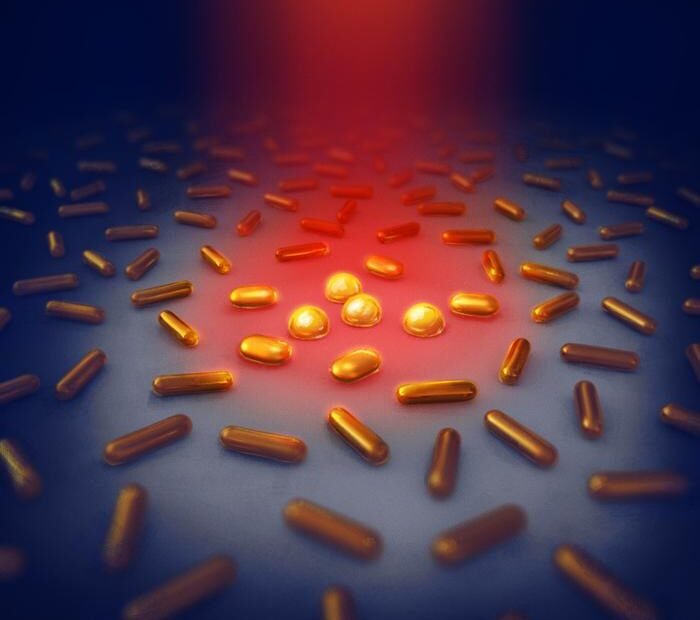
The illustration shows how the gold nanorods heat up when illuminated with NIR light. From a temperature of 120 degrees Celsius, the gold rods begin to change their shape and their optical properties change.
Credits Daniel Spacek Neuron Collective neuroncollectivecom
LabNews Media LLC
The Editors in Chief of labnews.ai are Marita Vollborn and Vlad Georgescu. They are bestselling authors, science writers and science journalists since 1994.More details about their writing on X-Press Journalistenbüro (https://xpress-journalisten.com).More Info on Wikipedia:About Marita: https://de.wikipedia.org/wiki/Marita_Vollborn
About Vlad: https://de.wikipedia.org/wiki/Vlad_Georgescu
The Editors in Chief of labnews.ai are Marita Vollborn and Vlad Georgescu. They have been bestselling authors, science writers, and science journalists since 1994.More details about their writing at X-Press Journalistenbüro (https://xpress-journalisten.com).More Info on Wikipedia:About Marita: https://de.wikipedia.org/wiki/Marita_Vollborn
About Vlad: https://de.wikipedia.org/wiki/Vlad_Georgescu
Forschende der Universität des Baskenlandes (EHU) haben ein robustes Protokoll entwickelt, um Metaboliten und Lipide in Spermien auch bei geringen Zellzahlen zu analysieren. Die Methode…
Das Basalzellkarzinom (BCC) ist die häufigste Hautkrebsform und tritt meist an sonnenexponierten Stellen auf. Selten manifestiert es sich jedoch an den Fingern. Ein Fallbericht beschreibt…
Die absolute Zahl viraler Hauterkrankungen ist weltweit stark angestiegen. Zwischen 1990 und 2021 nahm die Prävalenz um 36,29 Prozent auf 136,8 Millionen Fälle zu, die…
To provide the best experiences, we use technologies like cookies to store and/or access device information. Consenting to these technologies will allow us to process data such as browsing behavior or unique IDs on this site. Not consenting or withdrawing consent may adversely affect certain features and functions.
Functional
Always active
The technical storage or access is strictly necessary for the legitimate purpose of enabling the use of a specific service explicitly requested by the subscriber or user, or for the sole purpose of carrying out the transmission of a communication over an electronic communications network.
Preferences
The technical storage or access is necessary for the legitimate purpose of storing preferences that are not requested by the subscriber or user.
Statistics
The technical storage or access that is used exclusively for statistical purposes.The technical storage or access that is used exclusively for anonymous statistical purposes. Without a subpoena, voluntary compliance on the part of your Internet Service Provider, or additional records from a third party, information stored or retrieved for this purpose alone cannot usually be used to identify you.
Marketing
The technical storage or access is required to create user profiles to send advertising, or to track the user on a website or across several websites for similar marketing purposes.