Researchers from UPM and CIBER-BBN, in collaboration with various international institutions and organizations, have developed an artificial intelligence (AI) system designed to aid in the detection of radiological signs of pulmonary tuberculosis in chest X-rays of children. The work, published in Nature Communications, is the first study to systematically evaluate the value of lateral X-rays in this context and compare age-specific models with general models trained on all age groups.
Collaborating partners include the Barcelona Institute for Global Health (ISGlobal, a center supported by the "la Caixa" Foundation), the Manhiça Health Research Center (CISM) in Mozambique, the Spanish Pediatric Tuberculosis Study Network (pTBred), the Biomedical Research Network Center for Infectious Diseases (CIBERINFEC), and the Children’s National Hospital (Washington DC, USA).
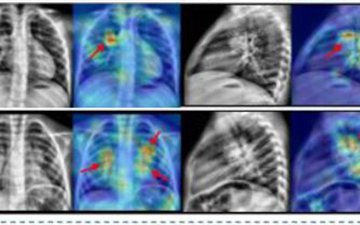
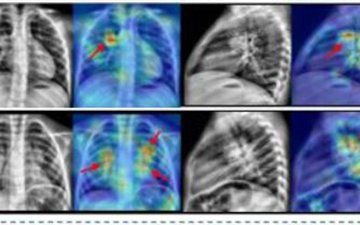
Activation maps generated using explainability techniques, highlighting the areas used by the model for its decisions regarding the X-rays.
Tuberculosis in children presents a diagnostic challenge, as symptoms are often nonspecific and radiological findings tend to be more subtle and variable compared to adults. To address these difficulties, the system integrates frontal chest X-rays and, when available, lateral X-rays. The system has been optimized to improve its efficiency and has been trained and validated with data from various hospitals and epidemiological facilities.
The work provides three key contributions. First, it demonstrates that pre-training AI models on large collections of adult X-rays improves performance when these models are fine-tuned with pediatric data. Second, it highlights the utility of lateral X-rays, which provide particularly valuable complementary information in infants and young children, where the frontal view may be insufficient. Third, it shows that age-specific models outperform models trained on all age groups, reflecting the differences in disease development and clinical presentation across age ranges.
Source:
https://doi.org/10.1109/ISBI53787.2023.10230500