Skip to Content

Trump

The Trump administration has offloaded an American doctor infected with Ebola to Germany instead of treating him in a US high-security biocontainment facility, exposing significant gaps in domestic preparedness for high-consequence infectious diseases. Donald Trump. Credits: White House

Trump Offloads Ebola-Infected American Citizen to Germany

Berlin/Washington (LabNews Media LLC) – A US medical missionary infected with the Bundibugyo strain of Ebola virus disease (EVD) has been evacuated to Berlin's Charité University Hospital at the request of American authorities, rather than being treated on US soil. The decision by the Trump administration to outsource care for one of its own citizens to a foreign hospital has drawn sharp criticism, raising questions about the United States' capacity and willingness to manage high-consequence infectious diseases domestically amid ongoing cuts to global health infrastructure. Dr. Peter Stafford, a surgeon working with the Christian missionary organization Serge in the Democratic Republic of Congo (DRC), tested positive for Ebola after exposure while treating patients at Nyankunde Hospital in Bunia, eastern DRC. He was evacuated along with six high-risk contacts, including family members, and admitted to a specialized isolation unit at Charité… 

The Twilight of the Gods of Donald Trump

In the space of weeks, the second Trump presidency has entered a phase that bears an unsettling resemblance to the final act of Wagner's Götterdämmerung: a once-dominant figure, surrounded by flames of his own making, watches the structures he claimed to command begin to collapse. What began as a calculated show of strength against Iran has metastasized into a pattern of erratic decision-making that senior national-security professionals now describe, in private briefings and public retrospectives, as a direct threat to American and global stability. The sequence is now a matter of public record. On February 27, 2026, President Trump authorized Operation Epic Fury — a joint US-Israeli campaign of missile, drone, and airstrikes against Iranian nuclear and military targets. Within days he declared the Iranian military “destroyed.” Yet the conflict did not end. Instead, after a fragile two-week ceasefire, the… 

The Trump administration has offloaded an American doctor infected with Ebola to Germany instead of treating him in a US high-security biocontainment facility, exposing significant gaps in domestic preparedness for high-consequence infectious diseases. Donald Trump. Credits: White House

Experts question Trump's mental state

Following sharp threats from US President Donald Trump against Iran, politicians and former confidants of the president have interpreted his remarks as evidence of possible mental illness. Democratic lawmakers called for an investigation and possible impeachment under the 25th Amendment. The accusations build on a long-standing debate among mental health experts and former staffers. The trigger for the latest criticism was Trump's statement regarding an ultimatum to Iran. The president threatened, among other things, that "an entire civilization" would "go under tonight" and used terms like "crazy bastards" in Truth social media posts. Democratic Congresswoman Yassamin Ansari wrote on the X platform that Trump is "clearly mentally ill and incompetent." She called for the application of the 25th Amendment, which allows for impeachment in cases of incompetence. Other critics expressed similar sentiments: Trump's words showed that he is "mentally ill" and "a lunatic." The debate is not new. As early as 2017, 27… 

Foreign policy: Americans distance themselves from Trump

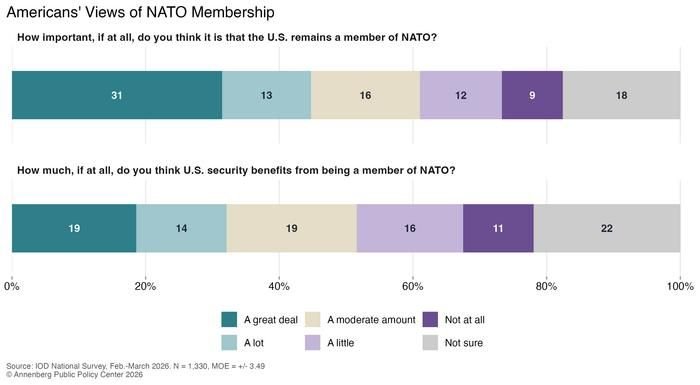
A representative survey by the Annenberg Public Policy Center (APPC) at the University of Pennsylvania found that a majority of Americans value U.S. membership in the North Atlantic Treaty Organization (NATO) and view it as an important security factor, but opinions are sharply divided along partisan lines. Furthermore, Republicans' views diverge depending on whether respondents identify primarily as supporters of President Donald Trump or more as supporters of the Republican Party in general. This pattern suggests a broader fragmentation of the party consensus regarding U.S. foreign policy commitments. The Annenberg survey, released after Trump's meeting with NATO Secretary General Mark Rutte at the White House on April 8, comes amid an ongoing debate among Republican leaders about U.S. participation in NATO. In early April, Senators Mitch McConnell (Republican from Kentucky) and Thom Tillis (Republican from North Carolina) distanced themselves from Trump after he suggested a possible withdrawal… 

Analysis: Known social connections between Melania Trump and Jeffrey Epstein

The known connections between Melania Trump and Jeffrey Epstein are limited exclusively to overlaps in the social circles of the early 2000s in New York City and Palm Beach. There is no documented evidence of a personal friendship, joint travel, involvement in criminal activities, or Melania Trump's knowledge of Epstein's crimes. Melania Trump was never listed on Epstein's flight logs and never visited his private island. Her name appears in the Epstein files because of social connections, not allegations or victim testimony. Melania Knauss met Donald Trump at a party in New York in 1998. At that time, the Trumps moved in the same high-society circles as Epstein and his longtime partner Ghislaine Maxwell. These overlaps led to occasional encounters at social events. On February 12, 2000, Donald Trump, Melania Knauss, Jeffrey Epstein, and Ghislaine Maxwell were all seen together at a party in… 

The Trump administration has offloaded an American doctor infected with Ebola to Germany instead of treating him in a US high-security biocontainment facility, exposing significant gaps in domestic preparedness for high-consequence infectious diseases. Donald Trump. Credits: White House

Why it's better for European science to decouple from Trump

Science thrives on stability, trust, and long-term planning. International collaborations—from joint research projects and the exchange of talent to shared data and infrastructure—require predictable partners. This predictability is precisely what is lacking under the current US administration of Donald Trump. For European research, it is therefore strategically wiser to break free from this dependence and consistently expand its own capacities. A partner who openly threatens NATO allies and treats science policy as a bargaining chip does more harm than good. Since his return to the White House, Trump's foreign policy has been characterized by a series of erratic maneuvers. This is particularly evident in his dealings with NATO. He has repeatedly threatened to withdraw the US from the alliance or effectively withdraw its mutual defense commitment if European states do not act according to his wishes. In the spring of 2026, the rhetoric escalated in the context of the conflict over… 

Iran as the political victor: The provisional ceasefire with the USA

The two-week ceasefire agreed upon Tuesday between the US, Israel, and Iran marks the provisional end of an escalation that has shaken the Middle East since February 2026. At first glance, it appears to be a pragmatic step to prevent further destruction. On closer inspection, however, Iran has achieved a clear political victory—not on the battlefield, but in the arena of power and credibility. The United States, under President Donald Trump, has been forced to back down from its maximalist demands and enter into negotiations based on Iranian proposals. The path to this point was characterized by erratic US policy that weakened its own position. Trump set deadlines, escalated and then retracted threats—from announcing massive attacks on civilian infrastructure to warning that “an entire civilization” was at stake. Within a few hours… 

Trump threatens Iran with the downfall of "an entire civilization" – critics see signs of cognitive dysfunction

US President Donald Trump has dramatically escalated his rhetoric in the conflict with Iran, warning that an "entire civilization" will perish tonight if Tehran does not back down and open the Strait of Hormuz. The apocalyptic and contradictory statements made on Tuesday have sparked renewed debate in the US about the 79-year-old president's potential cognitive dysfunction. In a Truth social media post, Trump wrote: "A whole civilization will die tonight, never to be brought back again. I don't want that to happen, but it probably will." He also suggested that after a possible regime change, "different, smarter, and less radicalized minds could prevail" and called the moment "one of the most important moments in the long and complex history of the world." Simultaneously, he threatened to destroy all Iranian bridges and power plants by midnight: "They're going to have no bridges, they're going to…" 

Iran war drives up costs for reproductive medicine in the US

The ongoing war with Iran, which began on February 28, 2026, is impacting reproductive medicine in the US through indirect effects on global supply chains, rising energy and commodity prices, and logistical bottlenecks. While no immediate shortages of core drugs for in-vitro fertilization (IVF) or other fertility treatments have been reported, the closure of the Strait of Hormuz, the drop in air freight capacity in the Gulf of Mexico by up to 79 percent, and higher petrochemical costs are leading to noticeable price increases and operational challenges. US reproductive medicine, which performs hundreds of thousands of treatments annually, is feeling these pressures particularly with regard to temperature-controlled biologics, hormone preparations, and laboratory equipment. Before the war, the US market for reproductive medicine was one of the largest in the world, with estimates suggesting around 300.000 to 400.000 IVF cycles per year, representing a market value of several billion US dollars. The American Society for Reproductive Medicine (ASRM) reported rising demand prior to 2026, driven by later parenthood, medical indications, and improved access. President Trump… 

Iran war massively impacts life sciences research in Gulf states

The ongoing conflict between the US, Israel, and Iran, which began on February 28, 2026, has severely hampered life sciences research in the Gulf states. Air freight capacity in the region plummeted by up to 79 percent in the early days of the war, maritime traffic through the Strait of Hormuz is down to only ten percent of pre-war levels, and helium production in Qatar, which supplies a third of the global supply, has been significantly disrupted by attacks on the Ras Laffan gas field. Saudi Arabia, the UAE, and Qatar, which were considered emerging centers for clinical trials and biotechnology before the war, see their growth plans jeopardized. President Donald Trump set a deadline of 20 p.m. Eastern Time on April 7, 2026, for the complete reopening of the Strait of Hormuz. Failure to comply threatens further attacks on Iranian energy infrastructure and bridges. This escalation exacerbates logistical bottlenecks and threatens ongoing research projects in the…