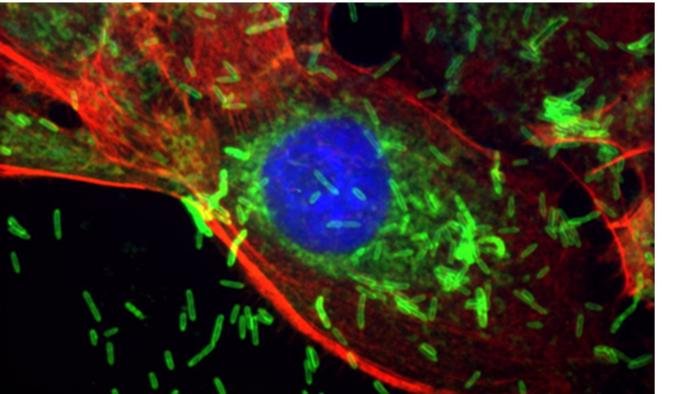
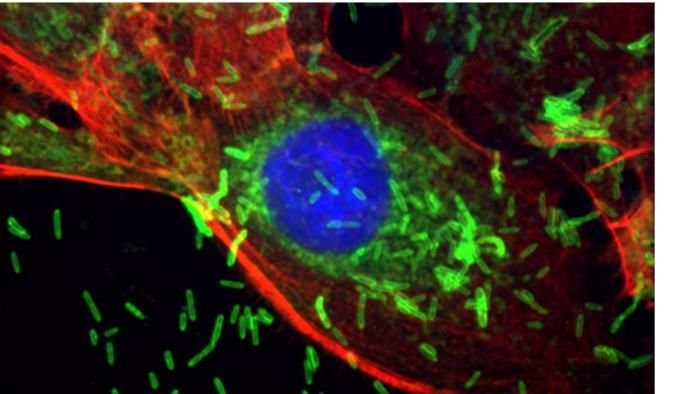
Researchers at Johns Hopkins Kimmel Cancer Center and its Bloomberg~Kimmel Institute for Cancer Immunotherapy found that an oral bacterium commonly associated with gum disease can promote breast cancer development, tumor growth, and spread by inducing DNA damage and altering cancer cell behavior.
The study, published Jan. 15 in Cell Communication and Signaling, shows that Fusobacterium nucleatum, a mouth bacterium previously linked to colon cancer and other cancers, can travel through the bloodstream to the breast tissue and cause inflammation and other precancerous changes there. Researchers led by Dr. Dipali Sharma, professor of oncology and associate director of the John Fetting Fund for Breast Cancer Prevention, found that in animal models of human breast cancer, the bacterium accelerated tumor growth and increased the spread of cancer cells from the breast to the lungs.
“The key takeaway is that this oral microorganism can be found in breast tissue and that there is a link between this pathogen and breast cancer,” says Sharma, adding that the team’s study was inspired by many small studies that examined thousands of patients and found a link between gum disease and breast cancer.
“We wanted to dig deeper and see if we could uncover the underlying connections,” says Sheetal Parida, Ph.D., lead author and research fellow who works with Sharma.
Using mouse models and human breast cancer cells, Sharma and her team found that intraductal exposure to F. nucleatum led to the formation of metaplastic and hyperplastic lesions in breast tissue—noncancerous changes where cells either multiply excessively or transform into a different cell type. These lesions were associated with inflammation, DNA damage, and increased cell growth. When the bacterium entered the bloodstream, it significantly accelerated the growth and spread of existing breast tumors.
The researchers also identified a molecular mechanism underlying these effects. Exposure to F. nucleatum caused DNA damage in the cells and activated repair pathways that can introduce errors, including non-homologous end joining (NHEJ), a fast but error-prone repair mechanism where cells repair damaged DNA by directly rejoining the broken ends. The researchers found that even brief exposure to the bacterium increased the expression of the protein PKcs, which has been linked to increased tumor cell migration, invasion, stem cell-like behavior, and chemotherapy resistance in connection.
Credits
Dr. Sheetal Parida and Dipali Sharma
The researchers also found that epithelial cells (the cells lining the breast's milk ducts) and breast cancer cells with BRCA1 mutations are particularly susceptible. BRCA1-mutated cells had higher concentrations of a surface sugar (Gal-GalNAc) that facilitates bacterial binding and invasion into the cell. Breast cells with BRCA1 gene mutations showed increased uptake and long-term storage of F. nucleatum , even across multiple cell generations, which amplified DNA damage and tumor-promoting effects.
“Our findings show a link between oral microbes and the risk and progression of breast cancer, especially in genetically predisposed individuals,” says Sharma. “Nothing happens in isolation. The findings suggest that multiple risk factors work together, with F. nucleatum acting as an environmental factor that may interact with inherited BRCA1 mutations to promote breast cancer and tumor aggressiveness.”