At an outside temperature of 40 °C, especially in combination with high humidity or lack of cooling, the physiological limits of thermoregulation are massively exceeded. The body attempts to lower core body temperature through cutaneous vasodilation and sweating, but with sustained exertion, core temperature rises rapidly. From approx. 40 °C core temperature, one speaks of heatstroke, a life-threatening deregulation with systemic inflammation, coagulopathy, and multiple organ failure. The biochemical changes in the blood are central to the high mortality – primarily due to thromboembolic events, disseminated intravascular coagulation (DIC), and electrolyte imbalances. These mechanisms are well documented in physiological studies, reviews on heatstroke-induced coagulopathy (HSIC), and epidemiological data on heat waves.
Cardiovascular and hemodynamic stress at 40 °C
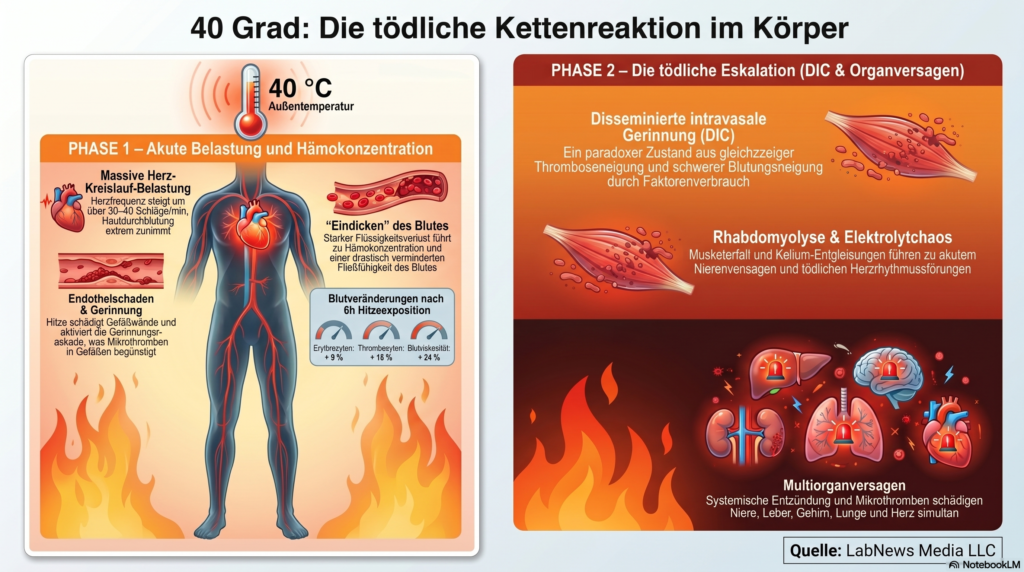
At an ambient temperature of 40 °C, skin blood flow increases extremely (up to an additional 7–8 l/min) to dissipate heat. This lowers peripheral resistance and requires massive compensation: heart rate increases by 30–40 beats/min or more, cardiac output increases, and myocardial oxygen demand rises. Simultaneously, blood is redistributed from the splanchnic and renal circulation. In cases of pre-existing coronary heart disease or heart failure, a demand-supply mismatch arises, which can trigger ischemia, arrhythmias, or acute decompensation. Dehydration exacerbates this through reduced central blood volume and increased sympathetic activity.
Epidemiologically, cardiovascular mortality increases by 11–15% during heat waves, with a particularly high risk of myocardial infarction, stroke, and heart failure exacerbation.
Dehydration, hemoconcentration, and hyperviscosity
Heavy sweating at 40 °C leads to rapid fluid loss (1–2 kg or more within a few hours). Despite drinking, a net deficit occurs because the sweat rate can exceed the intake capacity. Consequence: decrease in plasma volume (hemoconcentration).
Classic experiments under comparable heat stress showed increases in erythrocytes by approx. 9%, platelets by 18%, and blood viscosity by up to 24% within 6 hours. At 40 °C and sustained exposure, these effects intensify dramatically. The blood becomes "thicker," its flowability decreases – especially in small vessels. This favors stasis, platelet aggregation, and the formation of microthrombi in coronary and cerebral vessels.
Hyperviscosity is a direct mechanical risk factor for ischemic events, which often occur 1–2 days after the heat peak.
Prothrombotic state and activation of coagulation
Heat induces endothelial damage, release of tissue factor, and activation of the extrinsic coagulation cascade. Platelets are activated (increased count and adhesiveness), fibrinogen rises, and natural anticoagulants (antithrombin, protein C/S) are consumed or reduced by endothelial damage.
Additionally, plasminogen activator inhibitor-1 (PAI-1) increases, inhibiting fibrinolysis (hypofibrinolytic state). The result is a pronounced prothrombotic shift: increased thrombin-antithrombin complexes, fibrin monomers, and D-dimers. At 40°C and core temperature >40°C, this escalates to heatstroke-induced coagulopathy (HSIC).
Progression to disseminated intravascular coagulation (DIC) – the deadliest mechanism
In severe heatstroke (core temperature significantly above 40°C), HSIC develops into full DIC in up to 48% of cases. Triggers are:
- Massive release of damage-associated molecular patterns (DAMPs: HMGB1, histones, DNA) from damaged cells.
- Cytokine storm (IL-6, TNF-?, IL-1?) with inflammatory thromboinflammation.
- Neutrophil extracellular traps (NETs) and activated platelets forming microthrombi.
- Endothelial damage and glycocalyx loss? increased permeability and consumption of anticoagulants.
- In exacerbated heatstroke, additionally rhabdomyolysis (myoglobin, free heme? oxidative stress and further platelet activation).
In DIC, disseminated microthrombi form in all organs (consumption coagulopathy), followed by consumption of coagulation factors and platelets (thrombocytopenia). A paradoxical state arises: simultaneous tendency for thrombosis and bleeding. Labs: prolonged PT/aPTT, high D-dimers, low fibrinogen, platelet drop. Mortality massively increases with DIC (higher JAAM-DIC scores correlate with death).
Further deadly biochemical consequences:
- Rhabdomyolysis: CK increase, hyperkalemia, hyperphosphatemia, myoglobinuria? acute kidney failure and ventricular arrhythmias.
- Electrolyte imbalances: hyponatremia or hypernatremia, hypokalemia/hyperkalemia, hypomagnesemia? arrhythmias and muscle cramps.
- Endotoxemia: intestinal wall damage due to ischemia? LPS translocation? SIRS-like picture.
- Metabolic acidosis and elevated lactate: due to hypoperfusion and cell necrosis.
This cascade leads to multiple organ failure (kidney, liver, brain, lung, heart) and is one of the most common causes of death in heatstroke.
Temporal course and mortality risk at 40°C
The critical changes (hemoconcentration, hyperviscosity, incipient coagulopathy) begin within hours. With sustained 40 °C exposure without effective cooling and hydration, core temperature can rise to >40 °C within 30–60 minutes. Full DIC often develops within 24–48 hours. Epidemiologically, heat waves with 40 °C peaks correlate with significantly increased mortality from coronary and cerebral thrombosis, as well as acute cardiovascular failure.
Summary of lethal biochemical risks in blood at 40 °C:
- Hemoconcentration + Hyperviscosity ? mechanical tendency to thrombosis.
- Endothelial damage + Cytokine storm ? prothrombotic and hypofibrinolytic coagulopathy leading to DIC.
- Rhabdomyolysis + electrolyte chaos ? arrhythmias and AKI.
- Systemic inflammation + consumptive coagulopathy ? multi-organ failure.
These processes are not merely theoretical but are substantiated by laboratory studies (viscosity measurements, coagulation parameters), animal and human models, as well as clinical cohorts in heatstroke. Vulnerable groups (elderly, cardiovascular patients, diuretic users, obesity) are particularly at risk because their compensatory mechanisms are limited.
Prevention is crucial: Consistent hydration (with electrolytes), avoiding exposure to direct heat, cooling, medication adjustment, and early medical intervention at the first signs (dizziness, confusion, high heart rate). If heatstroke is suspected (core temperature >40 °C + neurological symptoms), immediate aggressive cooling and intensive care are necessary.
Disclaimer: This is an evidence-based medical overview based on current physiological and clinical literature. It does not replace individual medical advice or treatment. Seek immediate medical help for heat stress or symptoms.