A representative survey by the Annenberg Public Policy Center (APPC) at the University of Pennsylvania found that a majority of Americans value U.S. membership in the North Atlantic Treaty Organization (NATO) and consider it a significant security factor, though views are sharply divided along partisan lines.
Furthermore, Republicans' views diverge depending on whether respondents primarily identify as supporters of President Donald Trump or the Republican Party more generally. This pattern suggests a broader fragmentation of intra-party consensus regarding U.S. foreign policy commitments.
The Annenberg survey, released following Trump's meeting with NATO Secretary General Mark Rutte at the White House on April 8, comes amid an ongoing debate among Republican leaders about U.S. participation in NATO. In early April, Senators Mitch McConnell (R-Ky.) and Thom Tillis (R-N.C.) distanced themselves from Trump after he considered a potential U.S. withdrawal from the alliance, warning that such a move would jeopardize U.S. security. Senator Rand Paul (R-Ky.), however, supports Trump's stated desire to leave NATO and his constitutional right to withdraw without Senate consent.
Results
The survey by the Annenberg Public Policy Center's "Institutions of Democracy" division was conducted from February 17 to March 20, 2026, among a nationally representative sample of 1,330 U.S. citizens aged 18 and older. (You can download the key findings here.) The survey found the following:
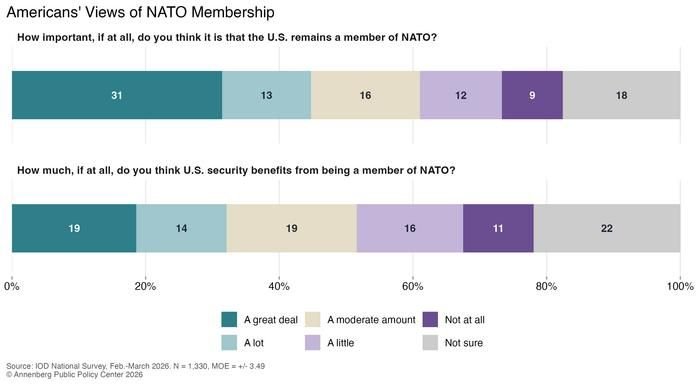
- A majority of adult Americans (61%) say that remaining in NATO is at least moderately important to them.
- Slightly more than half of Americans (52%) say that U.S. security benefits from NATO membership to a moderate or greater extent;
- Nearly four in ten Americans (38%) hold a somewhat or very positive view of NATO—more than double the proportion holding a negative view (18%).
- Among Republicans, there is a deep division: fewer than a quarter (22%) who primarily identify as Trump supporters say NATO benefits U.S. security to at least some extent, compared with nearly half (47%) of those who primarily identify with the Republican Party.
"Although President Trump has repeatedly condemned NATO and stated that he is considering the US withdrawal from it, the majority of Americans believe that the United States should remain a NATO member and that US security benefits from NATO membership," said Matthew Levendusky , director of the APPC's Program for Democracy in the Information Age and professor of political science and communication at the University of Pennsylvania.
The survey also asks whether US military interventions abroad tend to worsen or improve the situation in the affected countries. Overall, 42% say such interventions worsen the situation, while 20% believe they improve it. About four in ten Republicans (39%) believe US military interventions improve the situation in the affected countries, compared to only 6% of Democrats – a 33-percentage-point difference. Only 10% of independents believe US interventions improve the situation.