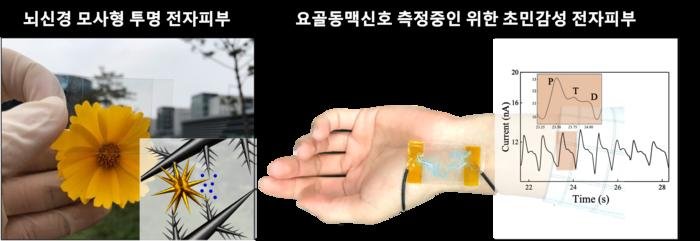
Based on joint research with Professor Jaehyuk Lim of Jeonbuk National University's Department of Mechanical Engineering, Professor Youngu Lee of Daegu Gyeongbuk Institute of Science & Technology's (DGIST; President Kunwoo Lee) Department of Energy Science and Engineering has successfully developed a highly sensitive pressure sensor for electronic skin that mimics the nervous system of the human brain. This technology is applicable to future devices, including AI-based digital healthcare devices, and is expected to be used in various fields due to its transparency and physical flexibility, such as transparent displays and wearable devices.
Pressure sensors are devices that detect slight changes or forces and convert them into signals. They are used in smartphones and medical devices to detect touch, heart rate, and muscle movements. Similar to human skin, electronic skin based on pressure sensors detects slight pressure and is therefore used in many different applications, including wearable devices, medical monitoring devices, and sensor systems for robots. To utilize electronic skin for more practical purposes, it is essential to go beyond simple pressure detection and achieve higher sensitivity, transparency, and flexibility. In this context, many studies are being conducted to improve performance.

The research team led by Professor Lee developed a pressure sensor that mimics the way the human brain transmits signals. The brain transmits signals in a complex and rapid manner as neurons and glial cells work together. Professor Lee's team created a nanoparticle network modeled after this structure and designed a pressure sensor that responds to slight pressure.
The pressure sensor developed in this study is not only highly sensitive but also highly transparent and flexible. It can detect slight changes such as heart rate and finger movements, as well as the pressure of water droplets. Furthermore, it operates stably even after 10,000 uses, and its performance does not degrade even in hot or humid environments.
Original Paper:
https://www.sciencedirect.com/science/article/abs/pii/S138589472406666X?via%3Dihub