Zum Inhalt springen

Researchers create artificial cells

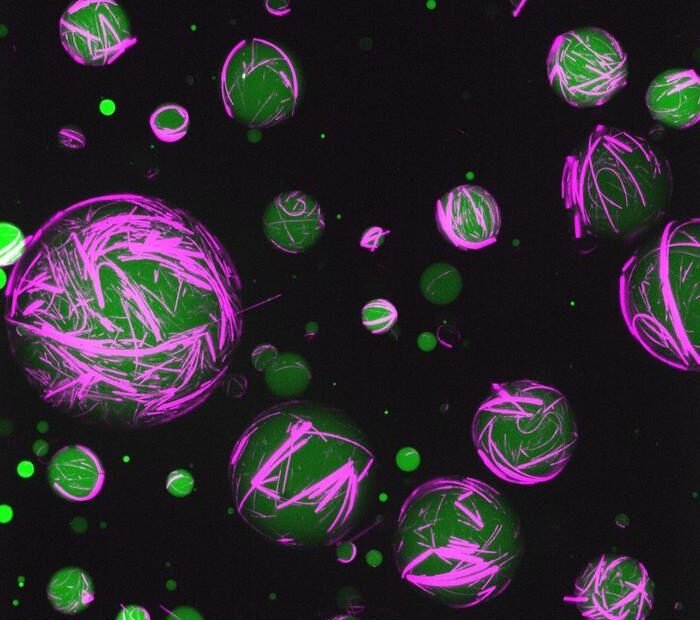
In a new study published in Nature Chemistry, UNC-Chapel Hill researcher Ronit Freeman and her colleagues describe the steps they took to manipulate DNA and proteins — essential building blocks of life — to create cells that look and act like cells from the body. This accomplishment, a first in the field, has implications for efforts in regenerative medicine, drug delivery systems, and diagnostic tools. “With this discovery, we can think of engineering fabrics or tissues that can be sensitive to changes in their environment and behave in dynamic ways,” says Freeman, whose lab is in the Applied Physical Sciences Department of the UNC College of Arts and Sciences. Cells and tissues are made of proteins that come together to perform tasks and make structures. Proteins are essential for forming the framework of a cell, called the cytoskeleton. Without it,… 
FDA approves immunotherapy drug combo for non-muscle invasive bladder cancer

The U.S. Food and Drug Administration (FDA) has approved the immunotherapy-boosting drug N-803, which is marketed under the brand name Anktiva, to be used in combination with the immunotherapy Bacillus Calmette-Guerin (BCG) for the treatment of patients with BCG-unresponsive non–muscle-invasive bladder cancer. The decision was based on results of the QUILT 3.032 clinical trial, which was led by Dr. Karim Chamie, associate professor urology at the David Geffen School of Medicine at UCLA and a researcher at the UCLA Health Jonsson Comprehensive Cancer Center. Findings from the phase 2/3 trial were presented at the 2022 American Society of Clinical Oncology annual meeting and published in NEJM Evidence. Chamie, who was the principal investigator for the trial, reported that this combination treatment resulted in longer overall survival and was more effective and safer than other treatments available for BCG-unresponsive non–muscle-invasive bladder… 

Microscopy demystifies metabolism of Alzheimer’s

Researchers at UC San Diego have deployed state-of-the art imaging techniques to discover the metabolism driving Alzheimer’s disease; results suggest new treatment strategies. Using their own state-of-the art imaging technologies, scientists at the University of California San Diego have now revealed how the metabolism of lipids, a class of molecule that includes fats, oils and many hormones, is changed in Alzheimer’s disease. They also revealed a new strategy to target this metabolic system with new and existing drugs. The findings are published in Cell Metabolism. The researchers discovered that in brains with tauopathy, neurons accumulate excess lipids as a result of stress or damage. This influx forces neurons to offload the excess to immune cells in the brain, called microglia. These microglia then mount an inflammatory response that causes further stress to neurons, triggering a repeating and worsening cycle. https://www.sciencedirect.com/science/article/abs/pii/S1550413124001189?via%3Dihub

World’s chocolate supply threatened by devastating virus

A rapidly spreading virus threatens the health of the cacao tree and the dried seeds from which chocolate is made, jeopardizing the global supply of the world’s most popular treat. About 50% of the world’s chocolate originates from cacao trees in the West Africa countries of Ivory Coast and Ghana. The damaging virus is attacking cacao trees in Ghana, resulting in harvest losses of between 15 and 50%. Spread by small insects called mealybugs that eat the leaves, buds and flowers of trees, the cacao swollen shoot virus disease (CSSVD) is among the most damaging threats to the root ingredient of chocolate. “This virus is a real threat to the global supply of chocolate,” said Benito Chen-Charpentier, professor of mathematics at The University of Texas at Arlington and an author of “Cacao sustainability: The case of cacao swollen-shoot virus co-infection”… 

Krebsdiagnose ruiniert viele US-Amerikaner

Eine neue Studie unter der Leitung von Forschern der American Cancer Society (ACS) verdeutlicht die nachhaltigen finanziellen Auswirkungen einer Krebsdiagnose für viele Erwachsene im erwerbsfähigen Alter und ihre Familien in den Vereinigten Staaten. Es zeigt eine Krebsdiagnose und die für die Behandlung erforderliche Zeit kann zu Beschäftigungsunterbrechungen, Verlust des Haushaltseinkommens und Verlust des arbeitsbezogenen Krankenversicherungsschutzes führen, was zu finanziellen Schwierigkeiten führt. In Kombination mit hohen Selbstbeteiligungskosten für die Krebsbehandlung berichten fast 60 % der Krebsüberlebenden im erwerbsfähigen Alter von mindestens einer Art finanzieller Notlage, wie z Pflege aus Kostengründen. Die Ergebnisse werden heute in CA: A Cancer Journal for Clinicians veröffentlicht. „Während die steigenden Kosten der Krebsbehandlung und die daraus resultierende medizinische finanzielle Not für Krebsüberlebende und Familien in den Vereinigten Staaten gut dokumentiert sind, wurde wenig darauf geachtet, wie sich eine Krebsdiagnose und -behandlung auf Beschäftigung und Haushaltseinkommen auswirken… 

Frauenanteil in technischer Forschung steigt langsam an

Der Frauenanteil ist in der technischen Forschung und Entwicklung im Jahr 2023 auf 18 Prozent gestiegen. Rund 42.000 Frauen arbeiteten zuletzt in diesem Berufsfeld, wie das Statistische Bundesamt (Destatis) am Dienstag mitteilte. Zehn Jahre zuvor waren Frauen mit einem Anteil von elf Prozent in der technischen Forschung und Entwicklung noch stärker unterrepräsentiert. Auch in der […] Frauenanteil in technischer Forschung steigt langsam an

Union und Grüne begrüßen Organspende-Vorstoß von Lauterbach

Politiker von Union und Grünen begrüßen Pläne des Bundesgesundheitsministeriums, die Nierenspende in Deutschland deutlich zu erleichtern. „Die Neuregelung wäre ein Lichtblick für viele tausend Betroffene, die auf ein Spenderorgan warten“, sagte der gesundheitspolitische Sprecher der CDU/CSU-Bundestagsfraktion, Tino Sorge, dem „Stern“. Entscheidend sei nun, dass die Neuregelung schnell und bürokratiearm umgesetzt werde. „Dafür wird der Einbezug […] Union und Grüne begrüßen Organspende-Vorstoß von Lauterbach

Luzerner Kantonsspital (LUKS) revolutioniert Dienstplanung mithilfe künstlicher Intelligenz

Zürich (ots) – Das Kantonsspital Luzern (LUKS) leistet mit Microsoft Schweiz und Polypoint Pionierarbeit bei KI-basierter Dienstplanung und kann den Planungsaufwand so um zwei Drittel reduzieren. Mit seiner Best Practice Initiative ist das LUKS Vorreiter im Schweizer Gesundheitswesen und trägt durch eine effizientere Dienstplanung zu mehr Effizienz und einer besseren Patientenversorgung bei. Das Luzerner Kantonsspital […] Luzerner Kantonsspital (LUKS) revolutioniert Dienstplanung mithilfe künstlicher Intelligenz

Cidara Therapeutics Announces Reverse Stock Split

SAN DIEGO, April 22, 2024 (GLOBE NEWSWIRE) — Cidara Therapeutics, Inc. (Nasdaq: CDTX) (the Company), a biotechnology company using its proprietary Cloudbreak® platform to develop drug-Fc conjugate (DFC) immunotherapies designed to save lives and improve the standard of care for patients facing serious diseases, today announced that the Company effected a reverse stock split of its issued and outstanding common stock, at a ratio of 1-for-20. The effective time of the reverse stock split will be 5 p.m. ET on April 23, 2024. The Company’s common stock will begin trading on a split-adjusted basis commencing upon market open on April 24, 2024. Cidara Therapeutics Announces Reverse Stock Split

Report of transactions of shares and related securities of Bavarian Nordic

COPENHAGEN, Denmark, April 22, 2024 – Bavarian Nordic A/S (OMX: BAVA) has today received information about the following transactions of the company’s shares/related securities by persons holding managerial responsibilities and/or persons/companies closely associated with such. Report of transactions of shares and related securities of Bavarian Nordic by persons holding managerial responsibilities and/or persons/companies closely associated with such