

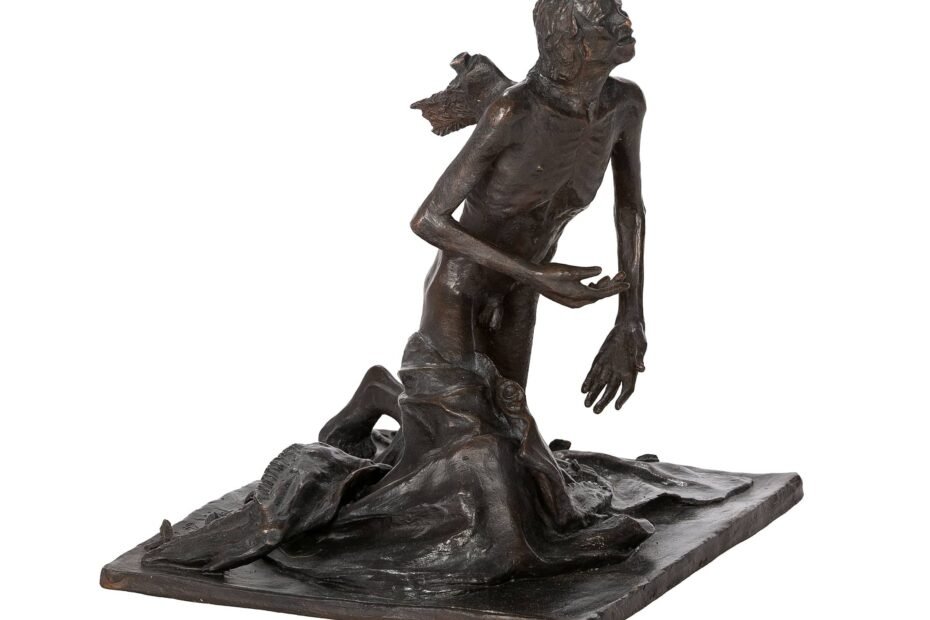
Marita Vollborn shapes in clay and bronze what cannot be said in words. At the Chianciano Biennale, her sculpture „ARES“ was not only recognized – it has now entered the museum’s permanent collection and simultaneously qualifies the artist for the London Art Biennale 2027. That she nevertheless avoids the US art market is not a whim, but a consequence.
Some artist biographies can be told in straight lines. Marita Vollborn’s life unfolds in ruptures, and perhaps that is precisely why her sculptures are so rarely smooth. Born in Erfurt in 1965 and raised in the GDR, she now works as a sculptor, journalist, and author – a triple role that initially sounds like distraction but is in fact a precisely calibrated system. Research supplies the facts; sculpture supplies what lies between them.
Since 2010 she has devoted herself intensively to sculpture. Her long-term project bears the programmatic title „Sinn und Scherben®“ (Sense and Shards) and comprises around fifty clay and bronze works. The name is no coyness about fragility but a set of working instructions: shards are the material from which sense must first be assembled. Her figures are expressive, often fragmented, never ingratiating. They deal with power and guilt, with loss and courage, with the ambivalences that public discourse likes to hide behind smooth formulas.
The international breakthrough – if one may speak of such a thing in connection with a biennale participation – came with a sculpture that is anything but a symbol of peace. „ARES,“ named after the Greek god of war, was created in 2015, measures just under 34 centimetres in height, and was cast in a limited edition of twelve bronzes. What might at first glance look like a classic anti-war work is, on closer inspection, something more uncomfortable: a study of the profit motive behind conflict. „More than 80 million dead in two world wars have evidently not been enough to stop the arms race and war-mongering,“ Vollborn says. The sentence sounds like resignation but is meant as an indictment – against the mechanisms that turn violence into a business model.
The ninth Chianciano Biennale invited Vollborn as a „Selected Artist.“ From 15 to 29 August 2026, „ARES“ was on view at the Chianciano Art Museum in Tuscany, alongside some 300 artists from around the world. But that was not the end of it. After the biennale closed, Vollborn donated the sculpture to the museum as a permanent gift. „ARES“ has thus gone from a temporary exhibit to a fixed part of the collection – a public memorial in the heart of Italy that belongs not to the market but to the institution. For an artist who does not merely quote the phrase „Critical Art Comes Before Commerce“ but practises it, this is the most consistent form of recognition: the work remains accessible without being sold.
And the journey continues. According to the Chianciano Art Museum’s official list of winners, Vollborn is among the ten artists who, through their participation, have automatically qualified for the London Art Biennale 2027. There, „ARES“ will be shown next year as a loan from the Italian museum collection – a German sculptor travelling from Tuscany to Chelsea with a war god in her luggage who is not heroic but a warning. She did not win the Grand Prize at Chianciano; that went to the Italian Del Giudice. But the path to London is institutionally secured, and for a position that deliberately operates outside the major gallery centres, that counts for more than a trophy cabinet.
All the more remarkable, then, is what Vollborn declared in the same breath: an exhibition of the work in the United States is currently out of the question for her. The reasoning is as sober as it is firm. As long as democratic checks and balances remain eroded under President Donald Trump and travel is not reliably safe for critical voices, she is concentrating on European platforms. She explicitly respects the election result, she emphasises, but she does not accept the erosion of checks and balances. Her principle, she says, is: „Critical Art Comes Before Commerce.“ One can dismiss this as a gesture, as political activism that exhausts itself in a refusal. Or one can see in it the consistency of an attitude that runs through the entire oeuvre: art that is uncomfortable must not submit to the conditions of a market that rewards ingratiation. The fact that „ARES“ now stands permanently in a European museum and travels from there to London gives this attitude an institutional foundation that no refusal alone could create.
Vollborn is no loud provocateur. Her language is that of the journalist, precise and controlled, and that of the sculptor who thinks with her hands. „In sculpture I shape with my hands what cannot be put into words,“ she says. The sentence marks the boundary between her two professions and, at the same time, the bridge between them. As an investigative science journalist she learned to check facts and expose contradictions. As a sculptor she is not interested in resolving the contradiction but in its form. A sculpture like „ARES“ does not argue; it simply stands there – and forces the gaze to engage with it. Now it no longer stands for just two weeks but forever. And next year it will show whether London can bear the uncomfortable guest.
It would be too easy to reduce Vollborn’s work to its political dimension. Alongside „ARES“ stand works such as „Friedensengel a.D.“ (Peace Angel, Retired), a bronze from 2024 in which an emaciated angel with broken wings and feathers converted into arrows calls out to God – and receives no answer. Here too there is no slogan, but an image of a condition: peace has been retired from service, and no one has replaced it. The limited edition of fifteen copies does nothing to diminish the urgency emanating from this figure.
Perhaps the real significance of Vollborn’s work lies in this stubbornness of questioning. She does not ask whether art may be political – that question was settled for her long ago. She asks what happens when an artist draws the consequences from her own work: when the sculpture that deals with the abuse of power is not shown where the abuse of power has become a governing style, but instead finds its way into a museum collection that preserves it for posterity. One need not share this decision to recognise that here someone is taking her own biography seriously. Raised in the GDR, Vollborn knows what it means when institutional controls disappear. Her sculptures are not illustrations of that experience, but they bear its traces.
The Biennale in Chianciano is over, but „ARES“ remains. As part of the permanent collection, as a loan for London, as a bronze-cast question about the profits of war. Vollborn continues to work on „Sinn und Scherben,“ on new bronzes, on digital works that she combines with historical photographs from the post-reunification era. It is a work in progress, uncomfortable and unfinished, and precisely therein lies its attitude. An artist who shapes sense out of shards has learned that completeness need not be the goal. Sometimes it is enough to leave the crack visible – and to make sure it is not cleared away.

