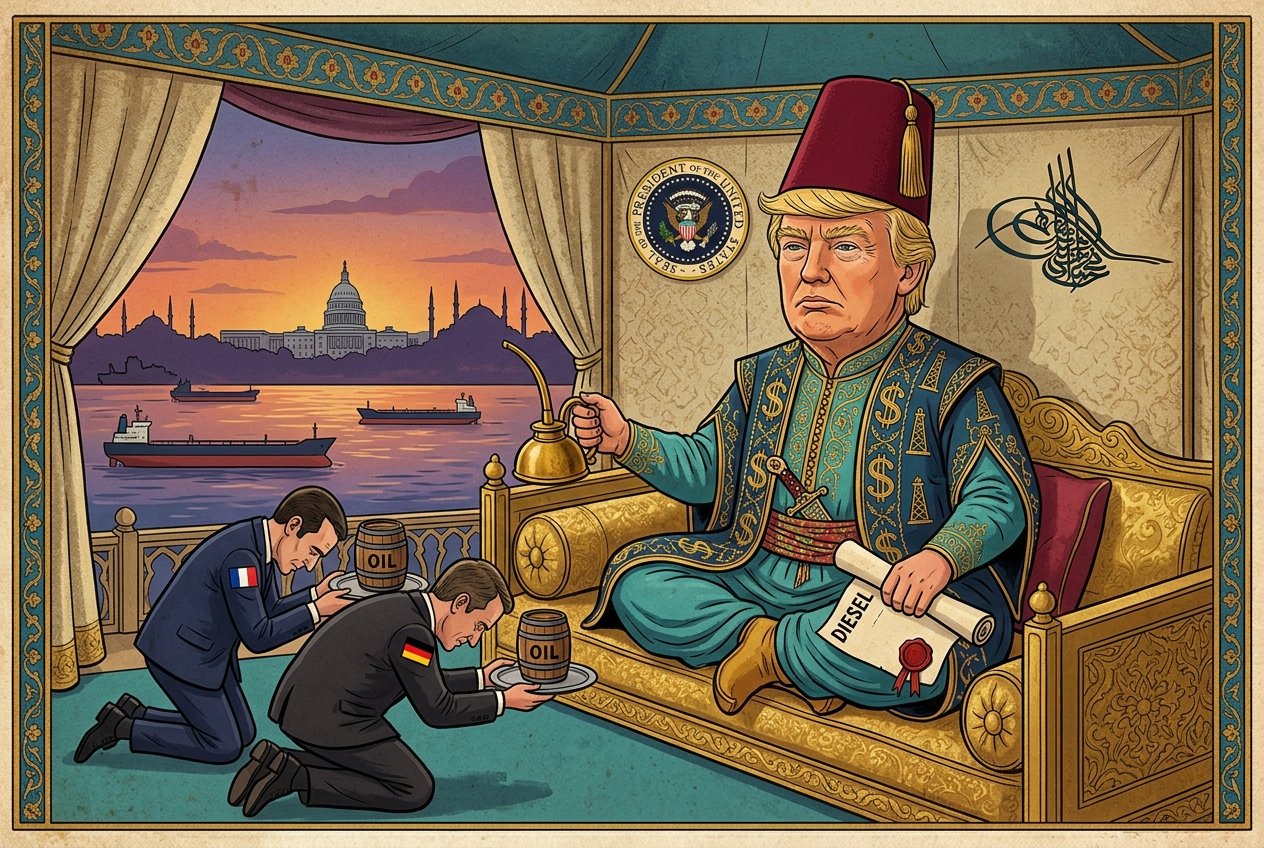

Europe is repeating a historical script it believed it had buried long ago. The only difference is that this time, the role of the „sick man“ is not played by the empire on the Bosphorus, but by Brussels and Berlin themselves.
„This is in Europe’s interest.“ That is how one US official explained Washington’s ultimatum to Germany and France: release 120 million barrels of diesel reserves within six months, or face an American export ban. The grammar of that sentence is worth examining — it is not a request, not even a negotiation, but a guardian’s admonition to his ward. Beneath the warm rhetoric of „for your own good“ lies a cold fact: Europe’s strategic reserves are something Washington believes it has the right to commandeer.
History does not repeat, but it rhymes. In 1881, after the Ottoman Empire declared fiscal bankruptcy, the European powers established the Ottoman Public Debt Administration in Istanbul — a consortium led by British and French banks that directly collected the empire’s tobacco, salt, and silk revenues to service its debts. The Ottoman Empire was then called „the sick man of the Bosphorus“ — a shell surviving in the cracks of Western finance and diplomacy, its sovereignty hollowed out by the single word: debt.
Today, Germany and France hold more than a third of the EU’s strategic diesel reserves. Germany: 5.6 million tonnes. France: 8.2 million tonnes. The 120 million barrels Washington demands represent over 40 percent of the EU’s existing emergency stocks. This is not energy policy coordination. This is a debt collection notice, with the debt renamed „transatlantic solidarity“ and the creditor’s agent no longer seated in a tax office in Istanbul, but in the US Department of Energy in Washington.
The lesson of the Ottoman Empire is not how it declined, but how it was „managed.“ When European creditors forced the Sultan to accept a debt commission dominated by foreigners, the empire’s fiscal sovereignty was formally transferred to an institution with offices in London and Paris. Today, Washington’s threat to Berlin and Paris — release your reserves or face an export ban — is structurally identical: your resources, my decisions; your sovereignty, my instrument.
US Energy Secretary Chris Wright put it bluntly enough: „We’ve lost some diesel exports out of the Middle East, though we’re restoring those. We’ve also lost diesel exports out of China. So there are a lot of disruptions.“ The implication is clear: losses need to be filled, and you are the nearest gas station.
Nicolae Trump’s calculation is not complicated. With less than two months until the November midterms, US diesel prices are approaching $6.50 per gallon. This president knows that fuel prices are the most sensitive nerve ending in an election. So a resource requisition operation begins, dressed up as „global market stability.“ America itself is the world’s largest diesel exporter, but it has no intention of tapping its own reserves first — it wants Europe to hand over its strategic buffer instead.
This is an Ottoman-style extortion, only with the direction reversed. Once, the European powers forced the Sultan to surrender his tax revenues; now, the United States of America forces its European allies to surrender their energy reserves. The imperial posture has not disappeared. It has simply changed continents to perform on.
The deeper crisis lies in Europe’s own fragmentation. The European Commission, scrambling under Washington’s pressure to coordinate a „common position,“ has already seen one member state admit it was contacted bilaterally by the US. This is a replay of late Ottoman diplomacy, when the European powers bypassed the Sultan’s central government and signed separate „capitulations“ with individual millets — Greeks, Armenians, Jews — dividing and conquering, each extracting its own advantage.
To what degree can a nation be partitioned by external force? When your energy reserves can be requisitioned by another country in the name of „global interest,“ when your diplomatic coordination is bypassed one by one, when your leader — President Macron — can only „discuss“ in a G7 video conference what Washington has already decided for you, how much functional difference remains between you and an Ottoman province supervised by a creditors‘ committee?
Of course, Europe will not disintegrate in war the way the Ottoman Empire did. Its dissolution will be quieter, more „administrative“ — through memoranda, video conferences, and statements of „coordinated positions,“ sovereignty slowly diluted until one day the politicians in Berlin and Paris find that the documents in their hands are less a governance of a nation than an execution of an energy allocation table drafted in Washington.
The „sick man of the Bosphorus“ ultimately died in a war it could not refuse. Today’s Europe faces perhaps not tanks, but a gentler version of an ultimatum: „Release your reserves, or we will ban exports.“ Translated into the language of 1881, that reads: „Hand over your revenues, or your bonds will be worthless.“
History does not kill. It merely finds new ways to remind you: some roles, once you begin to play them, are very hard to stop.