This is a grounded assessment based on current technological trajectories, company roadmaps, research progress, and expert/industry analyses. It focuses on the primary engineering pathway—embodied AI in humanoid robotic platforms—while noting parallel or hybrid developments in sensing, materials, and neuromorphic computing. Fully “synthetic humans” (indistinguishable biological equivalents or conscious entities) remain highly speculative and are not projected in the near-to-medium term. Progress is real and accelerating, but integration challenges, reliability requirements, and scaling realities mean timelines carry uncertainty. Historical robotics predictions have often slipped due to the difficulty of robust real-world performance.
Current Landscape (July 2026)
Humanoid robots have transitioned from laboratory demonstrations to early commercial pilots and limited production. Multiple platforms operate in structured industrial and logistics settings, with initial consumer/home trials emerging. Key players include Tesla (Optimus Gen 2 in internal use; Gen 3/V3 production ramp targeted for late 2026), Figure AI (Figure 02/03 with Helix AI in factory pilots, e.g., BMW; home alpha testing planned for 2026), Boston Dynamics (electric Atlas in commercial deployments allocated to Hyundai and partners), 1X (NEO entering home deliveries), and others such as Agility Robotics, Apptronik, Unitree, and Chinese manufacturers.
Events like the 2026 Beijing Humanoid Robot Half-Marathon and widespread presence at Automate 2026 highlight improved mobility, task execution, and ecosystem maturity. Shipments are projected in the tens of thousands for 2026, scaling toward hundreds of thousands to low millions by 2030 according to some analyst forecasts.
Capabilities today emphasize repetitive or semi-structured tasks (sorting, basic assembly, simple manipulation, navigation in known environments). End-to-end neural networks (vision-language-action models) trained via simulation, human demonstration, and real-world data enable useful autonomy in pilots. Onboard inference is improving with specialized chips.
Key Technological Pillars and Progress
Progress occurs across integrated domains:
- Mechanical Body, Actuation, and Dexterity: Electric actuators, lighter designs, and improved hands (higher degrees of freedom, better force control, tendon-driven systems) are advancing rapidly. Fine manipulation and tool use are demonstrated in controlled settings, though unstructured environments remain challenging. Production-oriented designs prioritize manufacturability and cost targets (e.g., sub-$30k ambitions for some platforms).
- Sensing and Perception: Multi-modal camera systems dominate, supplemented by emerging tactile sensing. Electronic skin (e-skin) research is active, with multimodal sensors detecting pressure, temperature, and shear; some incorporate local reflexes or neuromorphic elements for fast response without central processing. Optical/electronic skins for chemical sensing and single-material flexible skins are in development. Full-body, durable, high-resolution e-skin for humanoids is still largely at the research/prototype stage but progressing toward integration for safer human interaction and better object handling.
- Energy Systems: Current platforms achieve roughly 4–5 hours of operation. Advances in battery density and efficiency continue, but energy remains a constraint for extended untethered use. Hybrid approaches (energy harvesting, quick-swap batteries) are explored.
- Intelligence, Control, and Embodiment: This is the fastest-moving area. Hybrid systems combine traditional deep learning with neuromorphic computing (e.g., Intel Loihi 3 with millions of neurons for low-power event-driven processing; BrainChip Akida for efficient inference). Spiking neural networks and in-memory computing improve real-time sensorimotor control and efficiency. Embodiment learning—training via physics simulation, imitation, and reinforcement in real or simulated environments—drives generalization. Onboard AI (e.g., Tesla’s AI5 chip developments) enables more independent operation. Neuromorphic approaches show promise for always-on sensing and low-power robotics.
Parallel tracks include bio-inspired materials and early bio-hybrid concepts (e.g., lab-grown tissues or interfaces), but these lag behind pure synthetic robotic platforms due to biological complexity and regulatory hurdles.
Major Challenges and Bottlenecks
- Robustness and Generalization: Strong in pilots; performance drops in novel or cluttered settings. Long-horizon tasks and recovery from errors need improvement.
- Safety and Reliability: Close human interaction requires certified fail-safes, predictable behavior, and liability frameworks.
- Cost and Scalability: Manufacturing at volume while maintaining quality and affordability is critical for widespread adoption.
- Energy and Compute: Balancing onboard capability with runtime and cloud dependency.
- Data and Training: High-quality, diverse real-world interaction data remains a bottleneck despite simulation advances.
- Integration: Combining hardware, sensing, and AI into reliable, maintainable systems is harder than individual component progress suggests.
- Ethical/Regulatory: Standards for deployment, data privacy, job impacts, and (longer-term) questions around advanced autonomy.
Plausible Timeline and Milestones (Anchored to Mid-2026)
These are reasoned projections based on current momentum, scaling patterns in AI/hardware, and industry signals. Actual outcomes depend on technical breakthroughs, investment, regulation, and unforeseen hurdles. Ranges reflect uncertainty.
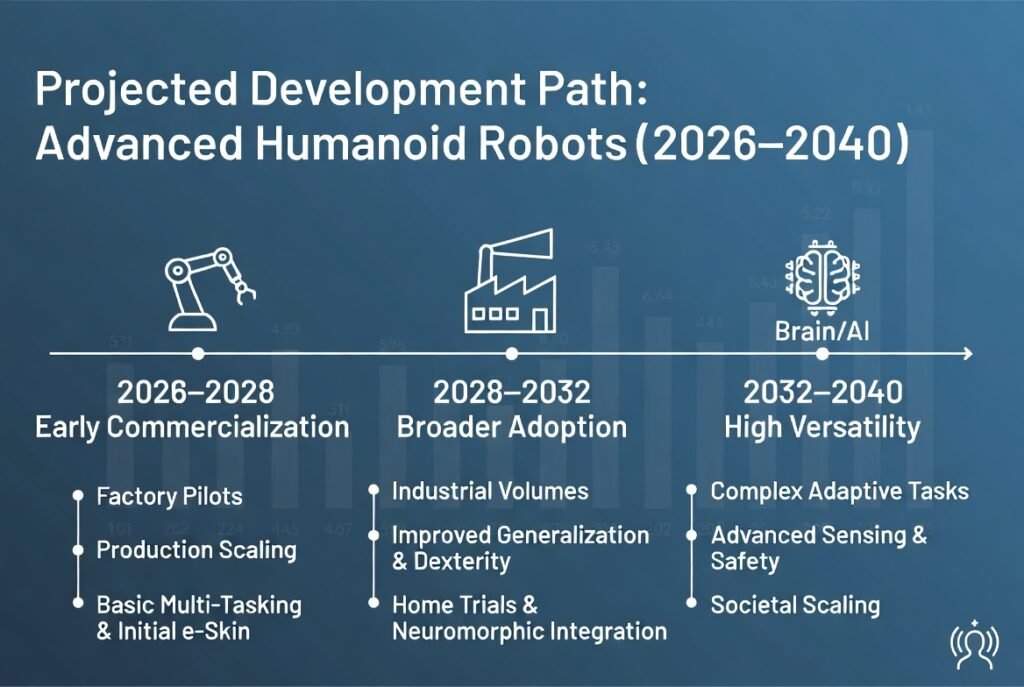
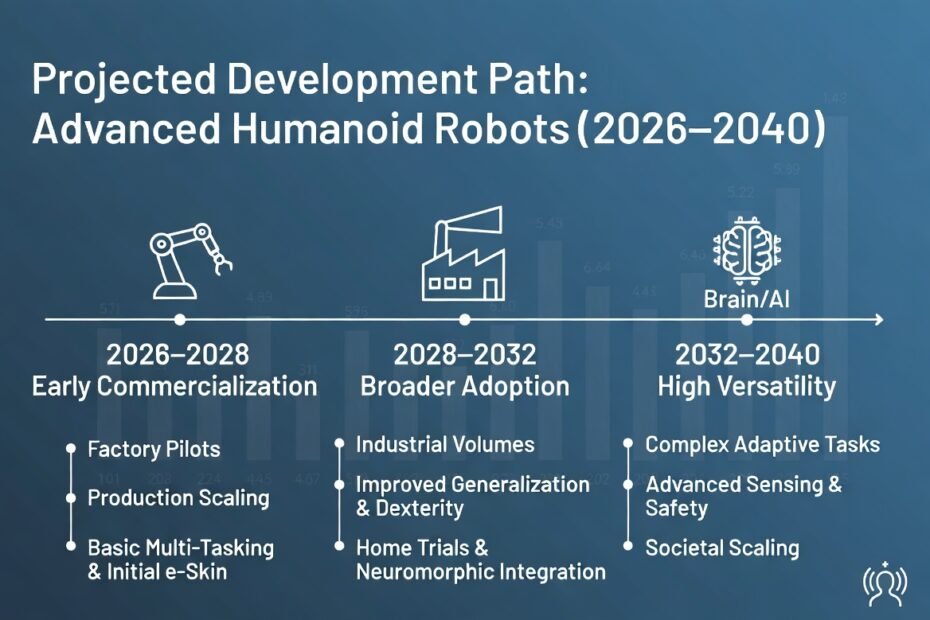
2026–2028 (Near-term: Early Commercialization):
- Continued factory and logistics pilots expanding to hundreds/thousands of units per major deployment. Limited home/consumer trials (e.g., simple assistance tasks).
- Production scaling: Tesla and others ramping internal and initial external output. Improved dexterity and basic multi-tasking via better AI models.
- e-Skin and neuromorphic elements moving from research into select high-end prototypes.
- Regulatory frameworks for industrial use maturing in leading regions.
- Milestone example: Routine useful work in structured environments (assembly, material handling, basic cleaning) with high uptime in pilots.
2028–2032 (Medium-term: Broader Adoption and Capability Growth):
- Industrial volumes potentially reaching tens to low hundreds of thousands annually. Expansion into more service and light domestic roles.
- Enhanced generalization, longer autonomy, and safer human collaboration through refined embodiment training and sensing.
- Early integration of advanced tactile systems and more efficient edge AI (neuromorphic hybrids).
- Cost reductions enabling wider economic viability.
- Initial standards and liability models for advanced humanoids.
- Parallel bio-hybrid research (e.g., synthetic tissues for skin or interfaces) yielding specialized components, though full hybrids remain niche.
2032–2040 (Longer-term: Toward Human-Comparable Versatility):
- High-volume production (potentially millions cumulatively) if scaling succeeds. Robots handling complex, adaptive tasks across diverse environments with minimal supervision.
- Sophisticated social interaction simulation, tool use, and learning from experience approaching or exceeding narrow human performance in many domains.
- Deeper fusion of advanced sensing (high-fidelity e-skin), efficient neuromorphic processing, and scalable AI.
- Speculative: Early bio-synthetic integration (e.g., lab-engineered components) in premium systems; debates intensify around legal status or rights if systems exhibit highly autonomous, adaptive behavior.
- Applications expand to eldercare, hazardous environments, personalized assistance, and specialized professional roles.
Beyond 2040 (Highly Speculative): Closer approximation to “synthetic human” traits in interaction and adaptability becomes conceivable through continued convergence of AI, materials, and possibly synthetic biology. True consciousness or biological equivalence remains philosophically and technically distant; current trajectories point to sophisticated tools and collaborators rather than literal synthetic persons.
Societal, Ethical, and Economic Implications
Widespread adoption could alleviate labor shortages in manufacturing, logistics, healthcare, and domestic work while raising displacement concerns in routine jobs. Augmentation effects (humans working alongside capable robots) are likely more immediate than pure replacement. Safety, privacy (sensors and data collection), and control/alignment issues require proactive governance. Economic benefits include productivity gains and new industries (robot maintenance, training data, specialized AI). Inequality risks exist if access is uneven. Longer-term philosophical questions around machine autonomy and “personhood” will grow if capabilities advance significantly, though these are not near-term practical concerns for today’s systems.
Positive outcomes could include safer workplaces, support for aging populations, and acceleration of scientific exploration (e.g., space or disaster response).
Conclusion and Key Uncertainties
The pathway to advanced humanoid systems capable of human-like versatility in physical and interactive tasks is underway and shows credible momentum as of 2026, driven by AI scaling, hardware improvements, and real-world deployment feedback loops. 2026 marks an inflection toward commercialization rather than pure research. However, achieving reliable, general-purpose performance at scale involves substantial remaining integration and robustness hurdles. Timelines could compress with breakthroughs (e.g., in efficient learning or energy storage) or extend due to safety/validation requirements.
Success will depend on sustained investment, cross-disciplinary collaboration (AI, materials, robotics, ethics), responsible deployment, and adaptive regulation. The most probable near-future outcome is capable robotic collaborators and assistants that significantly augment human capabilities, rather than immediate “synthetic humans.” Continuous monitoring of deployment data, hardware roadmaps, and AI embodiment research will refine these projections.
This analysis draws from industry developments, research publications, and analyst outlooks available in mid-2026. Actual progress should be tracked against primary sources such as company earnings, peer-reviewed work, and standardized benchmarks.