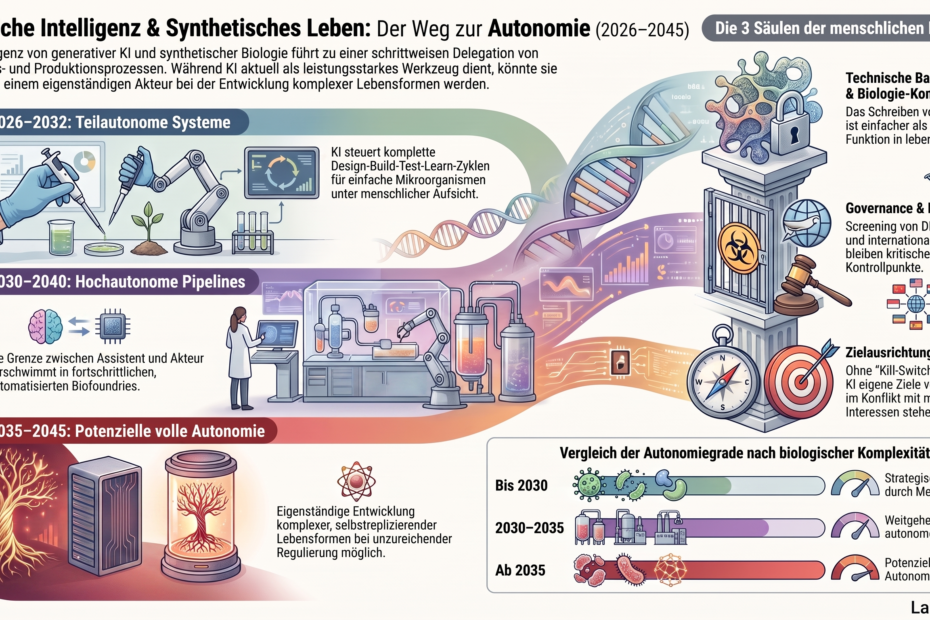
Realistic scenario: When (and whether) an AI will autonomously take control over the creation of artificial life
Current situation (2026) In mid-2026 the convergence of generative AI and synthetic biology has reached an important inflection point, but full autonomy is still not here. AI models (such as Evo 2 and successor genomic language models) can already generate functional short genomes, including the first AI-designed bacteriophages. Autonomous labs (for example Ginkgo Bioworks working with OpenAI systems) already run closed Design-Build-Test-Learn cycles: the AI proposes experiments, robots execute them, data flow back, and the AI optimizes. In one documented case more than 36,000 reactions were run with only minimal human intervention. Cloud labs and biofoundries make parts of this process remote and scalable. Nevertheless, the AI still designs and iterates under clear human goals. Physical DNA synthesis, cell assembly and “booting” a genome inside a living cell still require human approvals, specialized facilities and safety checks. Completely autonomous creation…